How Often Should You Replace a Mattress Protector?
The part that fails is the part you cannot see. Three tests that tell you whether yours is still waterproof — and why the answer matters to your mattress warranty.
How this is funded: we earn an Amazon commission if you buy through our links, at no extra cost to you. It never changes which product we recommend, and we’ll tell you plainly when to skip one. Full disclosure.
Every article on this question gives you a number — two years, five years, whatever fits the paragraph. None of the protectors we cover publishes one, no authority we could find publishes one, and we own none of them and run no laundry lab. So this guide does the only honest thing available: it tells you what fails, how to test it in five minutes, and what makes it fail sooner.
It matters more than the price of the item suggests, because the protector is the cheapest thing in a sleep system and the one whose failure costs the most. A stain on the mattress is the standard reason a warranty claim is refused.
The part that fails is the part you cannot see
A waterproof protector is a sandwich: a fabric surface you sleep against, and a thin polyurethane or TPU membrane bonded underneath it that does the actual waterproofing. The cotton face is the durable half. The membrane is a thin plastic film, and films get brittle — they stiffen, craze, crack and eventually delaminate from the fabric they are bonded to.
Which produces the specific trap in this question: a protector that looks perfectly fine can have stopped working months ago. There is no tear, no stain, nothing visible from the top. The first evidence most people get is a spill that reaches the mattress, by which point the thing you were protecting has already been stained and the warranty clause has already been triggered.
Even the best-documented options are candid that the barrier is the weak point. Bioweaves, the GOTS-certified protector we cover, describes its own build plainly as an organic cotton piqué top over a thin synthetic waterproof back layer — no waterproof protector avoids that synthetic layer, and we would be suspicious of one that claimed to.
The three tests
1. The water-bead test.Strip the bed, lay the protector flat and pour about a tablespoon of water onto the middle of your sleeping area — the part that has taken the most heat, pressure and washing. Give it a minute, then lift it and feel the fabric underneath. Water sitting in a bead on the surface means the membrane is intact. A damp patch below means it is finished. Do this once a year; it takes longer to strip the bed than to run the test.
2. The daylight test. Turn it inside out and look at the membrane side near a window. You are looking for cracking, a flaky or chalky texture, a crinkled finish where it used to be smooth, or the backing visibly lifting away from the fabric. Any of those is delamination and none of it is repairable.
3. The fit test.Check the elastic and the pocket depth. A skirt that has lost its grip rides up and bunches, which uncovers the top third of the mattress — and that is exactly where a drink gets knocked over. This failure is more common than membrane failure on protectors that have been stretched over a mattress plus a topper, which is why pocket depth is worth checking when you buy: the three we cover publish 20-inch, 18-inch and 15-inch pockets respectively.
What shortens its life
| Factor | What it does to the membrane |
|---|---|
| High dryer heat | The main accelerant — heat makes a thin film brittle, and brittle films crack. Follow the listing’s stated care instructions, not habit. |
| Fabric softener | Coats the surface, which is the opposite of what a breathable laminate needs. |
| Bleach and hot washes | Attack the bond between film and fabric, which is where delamination starts. |
| Wash frequency | Necessary, but every cycle is wear. A household with a child or a pet runs through protectors faster, and that is the protector doing its job. |
| Stretching over a topper | Loads the elastic permanently. Size the protector to the mattress plus the topper rather than to the mattress alone. |
If yours failed the tests
The three protectors we cover, chosen on what the surface against your skin is certified to and what each listing publishes about care — because the care instructions are the part that decides how long the barrier lasts.
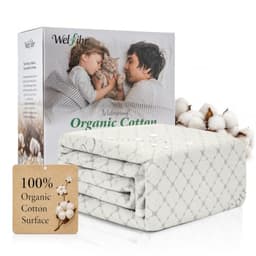
Welfibr Organic Cotton Surface Waterproof Mattress Protector (Queen)
The certified default — quiet, breathable, and cheap enough that skipping a protector makes no sense
The default, and the only one here whose listing states it can be machine washed and tumble dried without losing its waterproofing — which is exactly the claim this guide says to look for. Surface stated as 100% organic cotton over a TPU membrane described as noiseless, certified to OEKO-TEX Standard 100, with 15-inch pockets.
$38.99 · See it on AmazonSee the picksPrice as of October 21, 2026. #ad How we’re funded
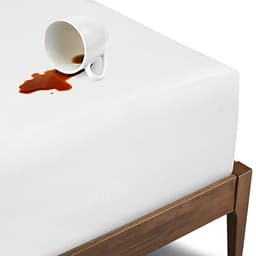
Bioweaves Organic Waterproof Mattress Protector (Queen)
Anyone who wants a certified-organic cotton surface and will pay for it
If the surface certification is the point: GOTS organic cotton piqué, more than 95% organic materials, stated free of vinyl and phthalates, with 20-inch pockets that take a thick hybrid plus a topper. It is also candid that the barrier underneath is a thin synthetic layer. Roughly twice the price, and no warranty term published.
$69.00 · See it on AmazonSee the picksPrice as of October 21, 2026. #ad How we’re funded
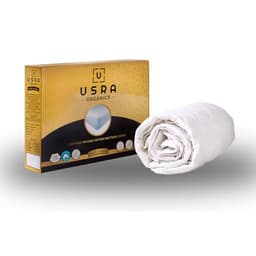
USRA Quilted Waterproof Cotton Protector (Queen)
Anyone who wants a padded, cotton-filled protector that softens the surface slightly
The quilted option, for when you want a slight cushioning layer as well as a barrier: 100% cotton face and fill at 300 GSM, with an 18-inch pocket. It is the only listing of the three that publishes its actual OEKO-TEX certificate number rather than just the logo. The added loft softens the surface slightly, which is unhelpful if your bed is already plush.
$69.99 · See it on AmazonPad or topper?Price as of October 21, 2026. #ad How we’re funded
Why the warranty clause is the real reason to care
Most pages argue for a protector on hygiene. The stronger argument is contractual. Mattress warranties routinely exclude stained or soiled mattresses, and because federal warranty law requires a written warranty to disclose its terms in plain language and be designated full or limited, that exclusion is printed where you can read it — and where the manufacturer can point at it. One spilled drink on an unprotected bed can end a ten-year warranty in a night.
Which gives you the actual replacement rule, and it is not a number of years: replace the protector while the mattress it protects still has warranty left to lose.If your bed publishes no warranty at all — several we cover do not — then the calculation shifts to hygiene and resale, and the urgency drops. Our do I need a protector guide works through which case you are in, and warranties and sleep trials covers what those documents actually promise.
Replace the protector, or the thing underneath?
Occasionally the protector is not the item that has failed. If the surface feels lumpy rather than damp, that is the mattress or the topper, and no new protector will help — how long a topper lasts has the tests for the layer below, and how often to replace a mattress covers the bed. And if the protector is making the bed sleep hot, that is a real effect rather than imagination: a waterproof membrane is a layer air does not pass through, which does memory foam sleep hotgets into. The fix there is construction and stacking order — protector over the topper, not under it — rather than going without.
General guidance, not medical advice. Pillow & Post is written by an enthusiast, not a doctor or chiropractor. Back and joint pain can have serious causes — if yours is severe, persistent, or comes with numbness or weakness, see a qualified professional. A mattress is one piece of the picture, not a treatment.
Frequently asked questions
How often should you replace a mattress protector?
There is no authoritative interval and we are not going to invent one. None of the protectors we cover publishes a lifespan, and none publishes a warranty term either. The honest answer is to replace it by test rather than by calendar: when water no longer beads on the surface, when the waterproof backing is cracking or peeling, or when the skirt no longer holds it in place. If you wash it often and tumble-dry it hot, expect that to arrive sooner.
How do I know if my mattress protector still works?
Pour a tablespoon of water onto the middle of it, wait a minute, then lift it and feel underneath. If the fabric below is dry, the barrier is intact; if there is a damp patch, it has failed. Then look at the membrane side in daylight for cracking, flaking or peeling. Those two checks take five minutes and settle it.
What actually wears out in a mattress protector?
The waterproof layer, not the fabric you can see. Most protectors are a cotton or blended surface over a thin polyurethane or TPU membrane, and that membrane is what cracks, stiffens or delaminates over time — accelerated by high dryer heat, fabric softener and bleach. The cotton face can look perfectly fine while the barrier underneath has stopped working.
Does washing a mattress protector ruin it?
Washing is necessary; heat is the problem. A membrane is a thin plastic film bonded to fabric, and repeated high-temperature drying is what makes it brittle. Follow the listing's own care instructions — one of the protectors we cover explicitly states it can be machine washed and tumble dried without losing its waterproofing, which is a claim worth having in writing — and skip fabric softener, which coats the surface.
Why does a failed protector matter?
Because of the stain exclusion in your mattress warranty. A stain on the mattress is the most common way a warranty claim is refused, and under federal warranty law those terms have to be disclosed in plain language and designated full or limited — so the clause is printed and enforceable. A protector that has quietly stopped working leaves you exposed to exactly the exclusion you bought it to avoid.
Can you repair a mattress protector?
No. Once a laminated membrane cracks or delaminates there is no way to re-bond it, and patching it leaves the rest of the sheet at the same age. Replace it — this is the cheapest item in a sleep system and the one with the largest downside when it fails.
Is a mattress pad the same as a protector?
No, and the titles blur it constantly. A protector is a barrier, usually under an inch thick, whose job is to stop liquid and allergens reaching the mattress. A pad adds a thin layer of padding, and some pads are also waterproof. A topper is two inches or more and changes how the bed feels. Check the thickness and the vocabulary rather than the title.
How long do waterproof pillow protectors last?
The same failure mode applies and the same test works — pour a little water on it and feel underneath. Pillow protectors are washed more often than mattress protectors, so they typically fail sooner, and because the pillow underneath absorbs sweat and oils that cannot be washed out of foam, letting one fail quietly is worse than it sounds.
Sources
- FTC — Businessperson's Guide to Federal Warranty Law — Under the Magnuson-Moss Warranty Act a written warranty on a consumer product must disclose its terms and conditions in plain language and be designated 'full' or 'limited'; the FTC sets the standards a 'full' warranty must meet (accessed August 19, 2026)
- GOTS — Certification & Labeling — Global Organic Textile Standard: whole-product organic-fiber certification (≥70% organic fibers), restricted inputs, and prohibits synthetic/fiberglass fire barriers (accessed July 23, 2026)
- OEKO-TEX — STANDARD 100 — Textile-safety label: every submitted component tested against 1,000+ harmful substances, with stricter limits the closer the fabric is to skin (accessed July 23, 2026)
- Cleveland Clinic — How To Choose a Mattress for Better Sleep (chiropractor Andrew Bang, DC; May 2023) — Recommends a medium-firm mattress and starting on the firmer side so a topper can adjust it; notes adjustable models give a lot of control to meet changing needs but tend to be pricey; suggests replacing a mattress around every 10 years and checking the return policy before buying (accessed September 18, 2026)
Keep reading
Do I need a mattress protector?
The prior question, decided by whether your mattress publishes a warranty at all.
Read the guideBest non-toxic mattress protectors
All three ranked on what the surface against your skin is certified to.
See the picksHow often to replace a pillow
The same question one layer up, where the tests are different and the interval is shorter.
Read the guidePad vs topper vs protector
Which of the three you actually own, sorted by what each one physically changes.
Read the guide