How Often Should You Replace a Pillow?
Every article gives you a number. No authority publishes one. Here is what the sources actually say, and the four tests that tell you the answer for your pillow.
How this is funded: we earn an Amazon commission if you buy through our links, at no extra cost to you. It never changes which product we recommend, and we’ll tell you plainly when to skip one. Full disclosure.
Nobody publishes the number
Search this question and you will be given an interval with great confidence — one year, two years, eighteen months. We went looking for the authority behind those figures and did not find one. The Cleveland Clinic, which is happy to put numbers on mattress replacement (roughly every six to eight years in its guidance on morning back pain, around ten years in its guidance on choosing a mattress), does not publish a pillow interval at all. What it publishes instead is a performance standard: the pillow should keep your head and neck in line with the rest of your spine, parallel to the mattress rather than bent up or down, and the right thickness for you depends on how firm your mattress is.
That is more useful than a number, because the number was never going to survive contact with reality anyway. A solid latex core used by a 120-pound back sleeper and a polyester pillow used by a 220-pound side sleeper who sleeps hot are not on the same clock, and no single interval describes both. So this page does what the honest version of this article has to do: it gives you the tests.
The four tests
1. The fold test. Fold the pillow in half and let go. A pillow with life in it springs back open. A finished one stays folded, or opens slowly and incompletely. This is the single best test because it measures exactly what you need at three in the morning: the ability to push back against the weight of your head rather than staying wherever it was last squashed. It works on fiber and foam alike.
2. The alignment test. Lie on your side in your own bed, in your normal position, and have someone look at you from behind. Your nose, breastbone and navel should be in roughly one line, and your head should not be tipped toward the mattress or propped up toward the ceiling. Then roll onto your back and check the same thing from the side: the chin should not be pulled down toward the chest. If the pillow fails this and it used to pass, it has lost loft. Our pillow loft guide has the full method.
3. The morning test.Do you wake with neck pain, stiffness or a headache that you did not go to bed with, and does it ease within an hour or two of getting up? That pattern — worse on waking, better with movement — points at a position held for hours rather than an injury, and the pillow is the thing setting that position. Our guides to sleeping with neck pain and pillows for neck pain and headaches cover the pattern in more detail.
4. The compensation test. This is the one people miss, because the compensation becomes invisible. Are you folding the pillow in half? Stacking a second one underneath? Tucking a forearm under your head? Punching it into a shape every night? Each of those is you manually adding the loft the pillow has stopped providing. A pillow that needs managing has already failed; the fact that you have stopped noticing you manage it is not evidence to the contrary.
What each fill type actually does over time
Nobody publishes verified lifespans, so what follows is structural reasoning rather than a tested claim — it describes how each construction behaves, not how many months it lasts.
Polyester fiber fill is the cheapest and the first to go. The fibers crush permanently under load and do not recover, which is why a bargain pillow feels luxurious for a month and like an envelope by month six. Shredded foam is different in an important way: it packs down, but the fill is accessible. A shredded pillow with a zippered liner can be re-tuned, fluffed back out, or topped up, which makes its usable life partly a function of whether you maintain it. Solid memory foam and latex coreshave nothing to migrate — they lose loft slowly and evenly rather than developing a crater, so the failure is gradual and easy to miss, which is why the fold test matters most on these. Kapok and other natural fibers compress with use and are usually designed to be topped up rather than treated as settled.
One maintenance note that genuinely extends life: wash the cover, not the core. Most of the pillows we cover have removable machine-washable covers, and the cover is where the sweat and skin cells collect. Foam cores are not laundry; several listings say so outright.
If it failed the tests, here is what to replace it with
Three picks chosen for how they age rather than how they feel in week one: one you can re-tune indefinitely, one cheap enough to replace without thinking about it, and one with a solid core and a certified fill. Full write-ups for each are one click away.

Coop Home Goods Original Adjustable Pillow
Anyone unsure of their loft, or who changes position through the night
The pillow whose loft is a setting rather than a countdown — shredded fill in a zippered liner, so when it packs down you can redistribute or top it up instead of binning it. Names CertiPUR-US and GREENGUARD Gold for the fill.
$89.00 · See it on AmazonFull reviewPrice as of October 5, 2026. #ad How we’re funded
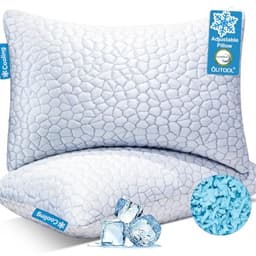
QUTOOL Cooling Adjustable Shredded Memory Foam Pillow (Queen, 2-pack)
Buying a certified-foam pillow for the guest room, or testing adjustable loft cheaply
The same adjustable mechanism at the lowest price here, sold as a pair — which makes replacing on a short cycle painless. CertiPUR-US stated for the foam only, with no certification named for the cover.
See the pillow roundup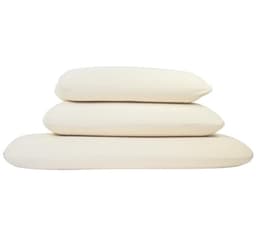
Turmerry Green Natural Latex Pillow (Standard, High Loft)
Back and side sleepers who want the fill itself certified, not just the cover
A one-piece zoned latex core with nothing inside to migrate or clump, and the clearest certification story of any pillow we cover: GOLS for the latex, GOTS for the cover, stated separately. The loft is fixed at the size you order.
$89.00 · See it on AmazonSee the pillow roundupPrice as of October 5, 2026. #ad How we’re funded
Before you buy the same pillow again
Two reasons not to simply reorder. The first is that your old pillow may never have been right — a pillow you have had for three years is a pillow you have adapted to, which is not the same as one that fits. Run the alignment test against the replacement, not against your memory of the old one.
The second is the Cleveland Clinic’s point about mattress firmness: the correct pillow height depends on how much your shoulder sinks into the bed. If you have changed mattress, added a topper, or your bed has softened with age since you bought the pillow, the loft you need has changed with it. That is also the argument for an adjustable pillow over a fixed contour if you expect anything underneath you to change — our adjustable versus contour comparison sets out the trade, and our combination-sleeper picks cover the case where one height has to serve several positions.
The one-line version
Stop asking the calendar. Fold it: if it stays folded, it is done. Lie on it: if your head is not level with your spine, it is done. Wake up with it: if your neck hurts in the morning and not in the afternoon, it is done. And if you are folding, stacking or punching it to make it work, it was done a while ago.
General guidance, not medical advice. Pillow & Post is written by an enthusiast, not a doctor or chiropractor. Back and joint pain can have serious causes — if yours is severe, persistent, or comes with numbness or weakness, see a qualified professional. A mattress is one piece of the picture, not a treatment.
Frequently asked questions
How often should you replace a pillow?
There is no authoritative interval, and we are not going to invent one. Replace a pillow when it fails the tests: it no longer holds your head level with your spine, it stays folded when you fold it, you wake with neck pain you did not go to bed with, or you are stacking or folding it to make up height. For most people that lands somewhere in the one-to-three-year range depending on the fill, but the test is the authority, not the calendar.
What is the fold test for a pillow?
Fold the pillow in half and let go. A pillow with life in it springs back open; a dead one stays folded, or opens slowly and incompletely. It works on fiber and foam fills alike because it measures the same thing a pillow needs at 3 a.m. — the ability to push back against your head rather than stay wherever you last compressed it.
Can a pillow cause neck pain?
Yes, and the Cleveland Clinic is direct about the mechanism: the pillow's job is to keep the head and neck in line with the rest of the spine, parallel to the mattress rather than bent up or down. A pillow that has flattened holds your head low all night; one that is too tall bends it the other way. Either produces a neck that hurts in the morning and eases during the day.
How long do memory foam pillows last compared with down alternative?
No one publishes verified lifespans, so treat any specific number you read with suspicion. What we can say is structural: a solid foam core has nothing to migrate, so it tends to lose loft slowly and evenly; shredded fill can be topped up or re-tuned, which extends its usable life if you maintain it; and polyester fiber fill compresses permanently and is usually the first to fail.
Does washing a pillow extend its life?
Washing the cover, yes — that is the part that collects sweat and skin cells, and most of the pillows we cover have removable machine-washable covers. Washing a foam core, no: foam is not designed to be laundered and several listings say so explicitly. Check what the listing allows before putting anything in a machine.
Should I replace my pillow or my mattress first?
The pillow, almost always. It costs a fraction as much, it is the thing that sets your neck angle, and the Cleveland Clinic notes that the right pillow height depends on mattress firmness — so replacing the bed first means re-solving the pillow anyway. For the mattress side of the question, the Clinic has given figures: roughly every 6 to 8 years in one piece of guidance, around 10 in another.
Sources
- Cleveland Clinic — Is Your Pillow Giving You a Stiff Neck While You Sleep? — Pillow height should keep the neck parallel to the mattress rather than bent up or down, and the right thickness depends on mattress firmness — a firmer bed needs a thicker pillow, a softer bed a thinner one (accessed August 12, 2026)
- Cleveland Clinic — Neck Pain: 6 Common Causes and Treatments — Advises that back and side sleepers use a pillow that keeps the head and neck aligned, and warns against sleeping on the stomach with the head turned. Names numbness or tingling in the arms, weakness or loss of coordination, pain after an accident, and pain with fever or unexplained weight loss as reasons to seek care promptly (accessed September 18, 2026)
- Cleveland Clinic — Why Your Lower Back Pain Is Worse in the Morning — Names sleep position, hours of immobility, and an unsupportive mattress as the usual causes; advises a medium-firm (~6/10) mattress, replacement roughly every 6–8 years, and stretching before getting up (accessed August 12, 2026)
- Cleveland Clinic — How To Choose a Mattress for Better Sleep (chiropractor Andrew Bang, DC; May 2023) — Recommends a medium-firm mattress and starting on the firmer side so a topper can adjust it; notes adjustable models give a lot of control to meet changing needs but tend to be pricey; suggests replacing a mattress around every 10 years and checking the return policy before buying (accessed September 18, 2026)
Keep reading
Best pillows for neck pain
The replacement list — the whole field ranked on neck support, with each listing's certifications named.
See the picksPillow loft for neck pain, explained
How to measure the gap you are filling before you buy a replacement at the wrong height.
Read the guideHow often to replace a mattress
The same question one layer down, where the published guidance actually exists.
Read the guideBest non-toxic pillows
If you are replacing anyway: the certified picks, with the scope of each badge spelled out.
See the picks