How to Sleep With Neck Pain
Back or side, never stomach; the pillow height that keeps the neck level; and the three symptoms that mean a pillow is not the answer.
How this is funded: we earn an Amazon commission if you buy through our links, at no extra cost to you. It never changes which product we recommend, and we’ll tell you plainly when to skip one. Full disclosure.
Most neck pain that is worst on waking has a simple explanation: the neck spent seven or eight hours bent in a direction it does not like, and the muscles and small joints at the top of the spine are letting you know. The Cleveland Clinic’s guidance on neck pain gives the fix in a sentence. If you sleep on your back or your side, use a pillow that keeps your head and neck aligned with the rest of your body; and do not sleep on your stomach with your head turned. Everything on this page is that sentence, unpacked into something you can act on tonight.
The order matters. Position first, because it decides how much pillow you need. Then pillow height, because it is the one pillow spec that determines whether the neck is level. Then the mattress, because it changes the pillow height. And at the end, plainly, the symptoms that mean none of this is the answer. None of it is medical advice.
Position one: on your back
Back sleeping asks the least of a pillow. Lying on your back, the only gap to fill is the curve at the back of your neck, and the pillow’s job is to fill it and no more. Too tall and the head is pushed forward, chin toward chest, and the neck flexes all night; too flat and the head tips back and the neck extends. The Clinic’s test for the right height is that the neck stays level with the mattress rather than bent up or down. A second rule from its guidance on sleeping with pain: keep the shoulders off the pillow. Support the head and neck only, because a pillow under the shoulders curls the upper spine forward and pulls the neck with it. A small pillow under the knees, which the Clinic recommends for the lower back, does not change anything at the neck end but makes the position easier to hold.
Position two: on your side
Side sleeping is fine for a sore neck, and it is the position that needs the most from the pillow. Lying on your side, the gap between your ear and the mattress is the width of your shoulder, less however far the mattress lets the shoulder sink in. A pillow that fills that gap keeps the neck level; one that does not leaves the head tilted down toward the bed all night, which is the most common way side sleepers wake up stiff. The other side-sleeping mistake is the arm: sleeping with the lower arm under the pillow or the head pushes the shoulder up and the neck into a tilt. Keep the arm below the pillow, and if the shoulder itself is sore, our neck and shoulder pain roundup covers the pillows with a cutout for it.
Stomach sleeping is the one to stop
The Clinic’s warning is specific: do not sleep on your stomach with your head turned. There is no way to breathe face-down without turning the head, so the neck is held twisted to one side for as long as you stay there, and any pillow at all adds extension on top of the twist. If it is the only position you fall asleep in, the damage-limitation version is the thinnest pillow you can tolerate or none, so the turn is as small as possible, and a slow campaign to fall asleep on your side instead — a body pillow to hug helps more than willpower does. Our stomach sleeper pillow page covers the low-loft pillows for people who are not ready to change.
The mattress changes the pillow height
This is the step most pillow advice leaves out, and the Clinic’s pillow guidance is explicit about it: the right pillow thickness depends on how firm your mattress is. A firmer bed lets the shoulder sink less, so a side sleeper’s gap is bigger and the pillow needs to be taller. A softer bed swallows the shoulder, the gap shrinks, and the same pillow becomes too tall. If your neck pain began after a mattress change, or after adding a topper, check the pillow before you blame either. Our pillow loft guide walks through measuring the gap and adjusting for the surface.
What to look for in the pillow
Given all of the above, the pillow specs that matter are few. First, a height you can get right for your position and your mattress — which for most people means either an adjustable fill you can add to or remove from, or a published loft figure you can match to your measured gap, rather than a word like “medium”. Second, a shape that suits the position: a flat or adjustable pillow for a back sleeper, a taller pillow or a cervical contour with room for the shoulder for a side sleeper. Third, because it is against your face for a third of your life, what the fill and cover are certified to, which is the filter this whole site applies. The picks below are chosen on those three things.
Pillows chosen on height, position and certification
Four from our registry, one for each situation the guide describes. We have not slept on them; each roundup argues its pick from what the listing states.
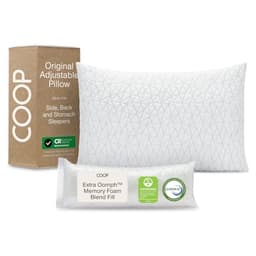
Coop Home Goods Original Adjustable Pillow
Anyone unsure of their loft, or who changes position through the night
For anyone unsure of their height: add or remove fill until the neck is level, in any position, with CertiPUR-US and GREENGUARD Gold both published.
$89.00 · See it on AmazonFull reviewPrice as of September 21, 2026. #ad How we’re funded
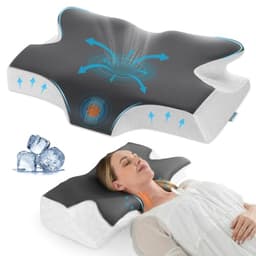
Elviros Cervical Memory Foam Pillow (Cooling)
Side sleepers whose neck kinks on a flat pillow
For committed side sleepers: a dual-height contour with shoulder cutouts, so the shoulder has somewhere to go and the neck sits level.
Full review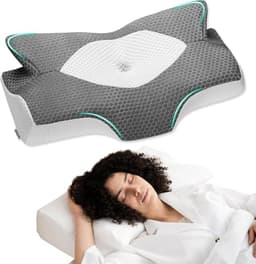
Elviros Cervical Memory Foam Pillow (Medium Firm)
Back sleepers who want a firmer cervical contour
For back sleepers who want a fixed contour: the loft profile that fills the curve of the neck without pushing the head forward.
Full review
Bluewave Bedding Ultra Slim Gel Memory Foam Pillow (2.75")
Back and stomach sleepers whose neck hurts because their pillow is too tall
For back sleepers whose pillow is simply too tall: a 2.75-inch slab with a published loft number and four other heights in the same line.
Full review
When a headache comes with it
A neck that has spent the night bent can produce a headache as well as a stiff neck. The Cleveland Clinic calls it a cervicogenic headache: head pain caused by a neck problem, typically one-sided, starting at the base of the skull or the back of the head and radiating forward, and worse with neck movement. It lists sleeping on a supportive pillow and mattress among the ways to prevent one. Everything on this page applies with more force if that is your morning, and our neck pain and headaches pillow roundup ranks the pillows on exactly that basis.
The three symptoms that mean a pillow is not the answer
A pillow is for the neck that is stiff on waking and looser by mid-morning. The Clinic’s neck-pain page names the situations that need a clinician rather than a shopping page, and they are worth repeating plainly: numbness or tingling in the arms, shoulders or legs; weakness in the legs or loss of coordination; pain that follows an accident; and neck pain with chills, fever or unexplained weight loss. Its list of causes includes the ones a pillow cannot touch — osteoarthritis, spinal stenosis, a herniated disc, a pinched nerve. If your neck pain fits any of that, or simply does not change after a week of the setup above, stop adjusting pillows and get it looked at. The Clinic’s home-care advice in the meantime is heat or cold for about fifteen minutes every few hours, gentle exercise, and attention to the posture you hold at a screen, which it names as one of the most common causes of neck pain in the first place.
General guidance, not medical advice. Pillow & Post is written by an enthusiast, not a doctor or chiropractor. Back and joint pain can have serious causes — if yours is severe, persistent, or comes with numbness or weakness, see a qualified professional. A mattress is one piece of the picture, not a treatment.
Frequently asked questions
What is the best sleeping position for neck pain?
Back or side, with a pillow that keeps the head and neck aligned with the rest of the body — that is the Cleveland Clinic's guidance. Back sleeping asks the least of the pillow, because the gap to fill is only the curve of the neck. Side sleeping works just as well if the pillow is tall enough to fill the gap left by the shoulder. Stomach sleeping is the one to stop.
Is it bad to sleep on your stomach with neck pain?
Yes. The Cleveland Clinic's neck-pain guidance warns against sleeping on your stomach with your head turned, because the neck is held twisted to one side for hours. If it is the only way you can fall asleep, use the thinnest pillow you can or none, so the head is turned as little as possible, and work on falling asleep on your side.
How high should my pillow be for neck pain?
High enough that your neck is level with the mattress, neither bent up nor down — the Cleveland Clinic's test. On your side that is roughly the width of your shoulder, less whatever the mattress lets the shoulder sink; on your back it is only the depth of the curve at the back of your neck. A firmer mattress needs a taller pillow, a softer one a thinner one.
Should I sleep without a pillow for neck pain?
Only if you sleep on your stomach, where any pillow adds to the twist. On your back, no pillow lets the head tip back and the neck extend; on your side, no pillow leaves the head tilted down toward the mattress all night. Both bend the neck for hours, which is what the pillow is there to prevent.
Can the wrong pillow cause headaches as well as neck pain?
It can contribute to one specific kind. The Cleveland Clinic describes cervicogenic headache as head pain caused by a neck problem, typically one-sided and starting at the base of the skull, and lists sleeping on a supportive pillow and mattress among its prevention strategies. If your neck pain comes with that headache, the pillow height matters even more.
When should I see a doctor about neck pain instead of changing my pillow?
The Cleveland Clinic names numbness or tingling in the arms, shoulders or legs; weakness in the legs or loss of coordination; pain that follows an accident; and pain with fever, chills or unexplained weight loss as reasons to seek care promptly. A pillow is for the stiff neck that is there on waking and eases as the morning goes on.
Sources
- Cleveland Clinic — Neck Pain: 6 Common Causes and Treatments — Advises that back and side sleepers use a pillow that keeps the head and neck aligned, and warns against sleeping on the stomach with the head turned. Names numbness or tingling in the arms, weakness or loss of coordination, pain after an accident, and pain with fever or unexplained weight loss as reasons to seek care promptly (accessed September 18, 2026)
- Cleveland Clinic — Is Your Pillow Giving You a Stiff Neck While You Sleep? — Pillow height should keep the neck parallel to the mattress rather than bent up or down, and the right thickness depends on mattress firmness — a firmer bed needs a thicker pillow, a softer bed a thinner one (accessed August 12, 2026)
- Cleveland Clinic — Cervicogenic Headache: What It Is, Symptoms & Treatment — Head pain caused by a neck (cervical spine) problem, felt as referred pain: typically one-sided, starting at the base of the skull or back of the head and radiating forward, worse with neck movement. Lists sleeping on a supportive pillow and mattress among its prevention strategies. Treatment is physical therapy first, then medication or nerve blocks (accessed September 18, 2026)
- Cleveland Clinic — Best Sleeping Positions for Pain — Back sleeping puts least pressure on the spine, with a small pillow UNDER the knees so the lower back does not over-arch; side sleepers put a pillow BETWEEN the legs to stop the top leg pulling forward and twisting the torso (accessed August 12, 2026)
Keep reading
Best pillow for neck pain
The full roundup — adjustable and contoured cervical pillows ranked on loft, fit and the certifications each maker states.
See the picksWhat pillow loft do you actually need?
How to measure the gap your shoulder leaves, and why the mattress changes the answer.
Read the guideBest pillows for neck pain and headaches
When the neck pain comes with a headache that starts at the base of the skull — the pillows that keep the neck neutral.
See the picksBest pillows for neck pain (side sleepers)
The taller, contoured picks for the position that needs the most pillow.
See the picks