How to Sleep With a Herniated Disc
Where the pillow goes matters more than which side you pick. The positions that unload the lower back, what changes when the disc is in your neck, and the honest read on your mattress.
How this is funded: we earn an Amazon commission if you buy through our links, at no extra cost to you. It never changes which product we recommend, and we’ll tell you plainly when to skip one. Full disclosure.
What is actually happening
A herniated disc is the soft center of a spinal disc pushing out through its tougher outer ring. The Cleveland Clinic notes they occur most often in the lower back or in the neck, and that a lower-back herniation commonly causes sciatica — pain running from the back down through the buttock and leg. That geographical split is why this page splits too: a lumbar disc is a problem of what your pelvis is doing all night, and a cervical disc is a problem of what your head is doing.
One piece of context before any of the positions. The Clinic advises resting for one to three days if the pain is severe, but warns specifically against long bed rest. Everything below is about making eight hours tolerable, not about spending more of the day lying down. This is general information rather than medical advice, and a disc that is being managed by a clinician should be managed by their instructions first.
The lumbar positions, in order
On your back, with a pillow under both knees. This is the default and it is the one with the clearest rationale. The Cleveland Clinic describes back sleeping as putting the least pressure on the spine, with a small pillow under the knees so the lower back does not over-arch. Lying flat with legs straight leaves the lumbar spine held in extension and the hip flexors pulling on it for hours; bending the knees a few degrees takes that pull off. The pillow wants to be low and firm rather than a soft one that flattens by midnight.
On your side, with a pillow between the knees.The reason this works has nothing to do with the knees. Without something between them, the top leg drops forward and down, which rotates the pelvis and takes the lumbar spine with it — a sustained twist at exactly the segment that is already unhappy. A contoured knee pillow stops the drop and keeps the hips stacked. If the pain runs down one leg, the Clinic’s sciatica guidance applies: lie on the side opposite the pain, which takes pressure off the affected nerve. Our sciatica sleep guide goes into that case in detail.
Curled on your side, knees drawn up.Worth trying, especially for people whose pain eases when they sit forward. The Clinic notes the curled side-lying position can help when the cause is spinal stenosis. It is not the position to default to — a whole night fully curled stiffens everything — but as a way of getting to sleep it is legitimate.
Face-down. The one to move away from. It holds the lower back in extension all night and, because the head has to turn, adds a sustained rotation at the neck. If you cannot fall asleep any other way, a flat pillow under the hips and the thinnest possible pillow under the head is the damage-limitation version; our stomach-sleeper pillow roundup covers that setup.
When the disc is in your neck
The lumbar advice does not transfer. For a cervical disc the variable is pillow loft: the head needs to stay in line with the rest of the spine, not propped forward by a tall pillow or dropped backward by a flat one. Two practical consequences. First, while symptoms are still changing, an adjustable pillow is a better purchase than a fixed cervical contour — you can re-tune it week to week instead of discovering that the shape you bought is a quarter-inch wrong. Second, stomach sleeping is out entirely, because it demands sustained rotation at precisely the segment involved.
The line worth repeating: numbness, tingling or weakness in the arms is not a pillow problem. Our pillow guide for neck pain with arm numbness sets out which version of that symptom is positional and which belongs in front of a clinician.
The objects that hold these positions
Three cheap ones and one that is not. Each does a single job from the positions above — support the knees, stop the pelvis twisting, raise the legs, or firm up a bed that has stopped holding the hips level. None of them treats a disc.
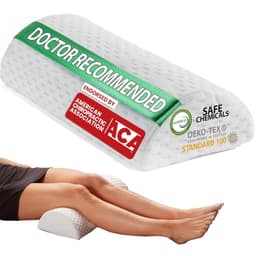
ComfiLife Half Moon Bolster Pillow
Back sleepers whose lower back aches from lying flat
The back sleeper's pillow: a firm half-moon bolster that sits under both knees and keeps them bent enough to take the arch out of the lower back. Firmer and lower than a folded pillow, which is the point — a soft pillow is flat by 2 a.m.
$32.95 · See it on AmazonFull reviewPrice as of October 5, 2026. #ad How we’re funded

5 STARS UNITED Knee Pillow for Side Sleepers
Side sleepers who want a certified foam against their skin all night
The side sleeper's pillow: a contoured block between the knees that stops the top leg dropping forward and rotating the pelvis. The one knee pillow we cover whose listing names a foam certification.
$27.95 · See it on AmazonSee the knee pillow roundupPrice as of October 5, 2026. #ad How we’re funded
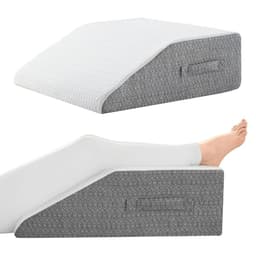
Nordjager Leg Elevation Pillow (8")
Back sleepers who want their legs raised rather than their torso
For people who only get comfortable with the legs properly raised rather than just bent — a firm 8-inch ramp that holds both legs up without the knees sliding off, which a stack of pillows will not do.
See the wedge roundup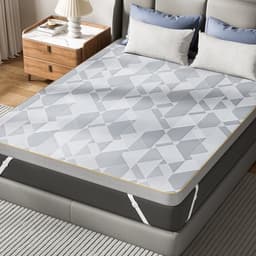
PERLECARE Firm Mattress Topper, 3"
Back and stomach sleepers whose mattress has softened under the hips
If the bed itself lets your hips sink, no pillow arrangement survives it. A thin memory-foam surface over a firm base adds resistance rather than cushioning, with CertiPUR-US foam and an OEKO-TEX cover both named.
Full review
Is the mattress making it worse?
Two tests, both free. Lie on your back on your current bed and slide a hand under your lower back: if the gap is obvious and your hand goes in easily, your hips are sitting lower than your ribs and the bed is sagging. Then look along the surface from the side with the bedding off — a visible dip where you sleep is structural, and no pillow and no topper fixes a structural dip. Our guide to fixing a sagging mattress separates the cases where the base is the culprit from the ones where the mattress is finished.
The direction to move is well supported and frequently misread. People with disc pain often conclude they need the hardest bed available; the Kovacs randomized trial in The Lancet found the opposite, with medium-firm beating firm for chronic low-back pain, and the Radwan review in Sleep Healthreached the same conclusion across a body of controlled trials. Supportive means the pelvis stays level with the ribs. It does not mean unyielding, and a board-hard surface leaves a side sleeper’s spine bowed and a back sleeper’s lumbar curve bridging empty air. Our herniated-disc mattress roundup ranks beds on exactly that balance, and weights the sleep trial heavily, because this is the one buyer who most needs the option to send a bed back.
What a position cannot do
Sleeping well with a disc problem is damage limitation, and it is worth doing — a night spent in a position that pulls on the segment is a worse morning. But nothing on this page treats a herniation, and the Clinic is explicit that extended bed rest is counterproductive. Pain that is escalating, weakness in a leg or arm, foot drop, or any change in bladder or bowel control are medical matters and not shopping ones. Get those looked at; then come back and sort out the pillow.
General guidance, not medical advice. Pillow & Post is written by an enthusiast, not a doctor or chiropractor. Back and joint pain can have serious causes — if yours is severe, persistent, or comes with numbness or weakness, see a qualified professional. A mattress is one piece of the picture, not a treatment.
Frequently asked questions
What is the best sleeping position for a herniated disc?
On your back with a pillow under both knees, for most people — it keeps the lumbar spine neutral instead of arched. Side sleeping with a pillow between the knees is the close second and suits people who cannot settle on their back. Stomach sleeping is the one to avoid, because it extends the lower back for hours.
Which side should I sleep on with a herniated disc?
If the disc is sending pain down one leg, the Cleveland Clinic suggests lying on the side opposite the pain, which takes pressure off the affected nerve. If there is no leg pain, either side works as long as a pillow between the knees keeps the hips stacked and the pelvis from twisting.
Should I sleep on a firm mattress with a herniated disc?
Supportive, not hard. The Kovacs trial in The Lancet found medium-firm mattresses outperformed firm ones for chronic low-back pain, and the Radwan review reached the same conclusion. A board-hard bed leaves the lumbar curve unsupported; a sagging bed lets the pelvis drop. Medium-firm with a real comfort layer is the target.
Is the floor better for a herniated disc?
Usually not. The floor is firm but it is not supportive — it has no give for the shoulder or hip, so a side sleeper's spine bows and a back sleeper's lumbar curve is left bridging a gap. People who feel better on the floor are often reacting to a mattress that sags, and the right conclusion from that is a new mattress or a firm topper, not a permanent floor.
How should I sleep with a herniated disc in my neck?
The principle is the same but the object changes: the head has to stay level with the spine rather than propped forward or dropped back. That means controlling pillow loft rather than lumbar position — and while symptoms are changing, an adjustable pillow is a better buy than a fixed contour you cannot tune. Numbness, tingling or weakness in the arms is a reason to see someone rather than to buy a pillow.
Does a wedge pillow help with a herniated disc?
It can, for people who find flat lying uncomfortable — a gentle incline under the torso, or a leg wedge that raises the knees, both reduce the pull on the lower back. It is not a treatment and nobody should expect a wedge to resolve a disc problem; it is a way of holding a tolerable position for long enough to sleep.
Sources
- Cleveland Clinic — Herniated Disk (Bulging Disk): Symptoms & Treatment — A herniated disk is the soft center of a spinal disk pushing out through its outer ring; they most often occur in the lower back or the neck. A lower-back herniation commonly causes sciatica. Advises rest for one to three days if pain is severe but warns against long bed rest. Says nothing about mattresses or sleeping positions — the bedding reasoning on our page is ours (accessed September 18, 2026)
- Cleveland Clinic — How To Get Better Sleep With Sciatica Pain (physical therapist Cara Sieberth, PT; August 2025) — Back sleeping promotes spinal alignment; side sleeping on the side opposite the pain relieves pressure on the nerve, with a pillow between the knees; the curled side-lying position can help when the cause is spinal stenosis; stomach sleeping is generally discouraged but relieves a few people. Cites a review finding a medium-firm mattress best for lower-back pain (accessed September 18, 2026)
- Cleveland Clinic — Best Sleeping Positions for Pain — Back sleeping puts least pressure on the spine, with a small pillow UNDER the knees so the lower back does not over-arch; side sleepers put a pillow BETWEEN the legs to stop the top leg pulling forward and twisting the torso (accessed August 12, 2026)
- Kovacs et al. — Effect of firmness of mattress on chronic non-specific low-back pain (The Lancet, 2003) — Randomized double-blind trial (n=313): medium-firm mattresses outperformed firm for low-back pain and disability (accessed July 23, 2026)
- Radwan et al. — Effect of different mattress designs on sleep quality, pain reduction and spinal alignment (Sleep Health, 2015) — Systematic review of controlled trials: a medium-firm, self-adjusted mattress is optimal for sleep quality and spinal alignment (accessed July 23, 2026)
Keep reading
Best mattresses for a herniated disc
When the bed is the cause — support-first picks with the trial window weighted heavily.
See the picksHow to sleep with sciatica
The companion guide for when a lumbar disc sends pain down the leg.
Read the guideBest knee pillows
The pillow that goes between or under the knees — the cheapest object on this page and the most used.
See the picksBest firm mattress toppers
When the bed sags under the hips and replacing it is not on the table yet.
See the picks