How to Sleep With Sciatica
Which side to lie on, where the pillow goes, and why the fetal position helps some people and hurts others. The positions first, then the two cheap objects that make them stick.
How this is funded: we earn an Amazon commission if you buy through our links, at no extra cost to you. It never changes which product we recommend, and we’ll tell you plainly when to skip one. Full disclosure.
Sciatica is not a diagnosis so much as a description: pain that starts in the lower back or buttock and shoots down one leg, along the path of the sciatic nerve. The Cleveland Clinic says a herniated disc in the lower back commonly produces it, and its sleep guidance names spinal stenosis — narrowing of the spaces in the spine — as another cause. What the two causes share is that the nerve is being pressed, and what they do not share is the position that relieves it. That is why generic sleeping-position advice is so hit and miss for sciatica, and why this guide gives you a way to work out which version is yours.
The Clinic’s own sleep guidance for sciatica, written with a physical therapist, comes down to two positions and a pillow for each. This guide walks through those, adds the mechanical reasons behind each so you can adapt them, and then — only then — names the two inexpensive objects that make a good position hold for eight hours. None of it is medical advice, and the Clinic’s advice to avoid long bed rest for a herniated disc is worth keeping in mind: the goal is a night that does not undo the day, not a night spent lying still.
Position one: on your back, knees raised
Back sleeping promotes spinal alignment, in the Clinic’s words, and it is the position that spreads your weight over the largest area. On its own, though, lying flat lets the lower back arch over a gap between the mattress and the lumbar curve, and an arched lumbar spine narrows the space the nerve roots pass through. The fix is a pillow under both knees. Raising the knees tilts the pelvis back, the lumbar curve flattens toward the mattress, and the gap closes. It is the same geometry an adjustable base creates with its knee lift, for a fraction of the cost.
Keep the head pillow low. The Clinic’s instruction is to support the head and neck only, not the shoulders; a tall pillow that props the shoulders curls the upper spine forward and undoes some of what the knee pillow did. If you sleep on your back and wake with your hands above your head, that is worth breaking too: keep both arms in the same position so the spine is not twisted.
Position two: on your side, painful leg on top
Side sleeping is the Clinic’s other recommendation, with one rule that people get wrong more than any other: lie on the side that does not hurt. That puts the painful hip and leg on top, where nothing presses on them. Then bend the knees slightly and put a pillow between them. Without the pillow, the top knee drops toward the mattress, pulling the pelvis into a twist that loads the lower back for as long as you hold the position. With it, the hips stay stacked and the spine stays straight from the pelvis up.
A pillow behind the back is optional and worth trying if you tend to roll onto the painful side in your sleep; it stops the roll without waking you. And for people whose sciatica comes with hip pain on the painful side, the pillow between the knees does double duty — our guide to sleeping with hip pain explains why.
The fetal position: it depends on why the nerve hurts
This is where the cause matters. The Clinic notes that when sciatica comes from spinal stenosis, curling up on your side with the knees drawn toward the chest can help, because flexing the spine opens the narrowed spaces the nerve passes through. When the cause is a herniated disc, the same deep flexion can press the disc further and make things worse. You do not need a scan to use that: if curling up eases the leg pain, the position is doing something useful; if it sharpens it, straighten out and use the knees-slightly-bent version instead. Let the leg decide.
Stomach sleeping, and the exception
The Clinic generally discourages stomach sleeping for sciatica, because it forces the lower back into an arch and the head into a turn, and both are held for hours. It also records an exception: for a few people, arching the back is exactly what relieves the pain. If you are one of them, a thin pillow under the hips reduces the arch to something the lower back can tolerate, and a very low head pillow — or none — keeps the neck from paying for it. Our stomach sleeper pillow page covers the head end.
What to look for in the pillow that makes it hold
Any pillow works for one night. The reason people give up on the positions above is that an ordinary bed pillow between the knees ends up on the floor by 2 a.m., and a folded blanket under the knees flattens out. What makes a position hold is a pillow shaped for the job: a contoured block that sits between the knees without being gripped, or a low half-moon bolster that stays under both knees on your back. Height matters — roughly the width of your hips for the between-the-knees pillow, lower for the under-the-knees one — and so does the material against your skin all night, which is why we note which listings name a foam or textile certification and which do not.
Pillows that make the positions hold
Two for side sleepers and two for back sleepers, from our registry. Each is here because it does one of the jobs described above; the full roundups argue each one in detail.

5 STARS UNITED Knee Pillow for Side Sleepers
Side sleepers who want a certified foam against their skin all night
The between-the-knees block for side sleepers, and the only knee pillow we cover whose listing names both a foam and a textile certification.
$27.95 · See it on AmazonFull reviewPrice as of September 21, 2026. #ad How we’re funded
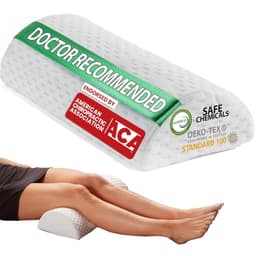
ComfiLife Half Moon Bolster Pillow
Back sleepers whose lower back aches from lying flat
The low half-moon bolster that goes under both knees for back sleepers — the same knee lift an adjustable base gives, at a fraction of the cost.
Full review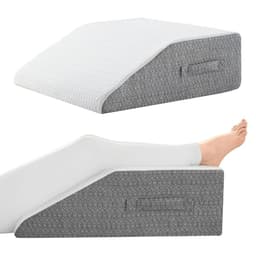
Nordjager Leg Elevation Pillow (8")
Back sleepers who want their legs raised rather than their torso
A wider, taller version of the same idea: both calves rest on it, the knees stay raised, and it does not shift when you move.
See the wedge roundup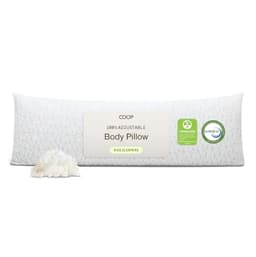
Coop Home Goods Original Adjustable Body Pillow (20" x 54")
Side sleepers who want to tune how much support sits under the top knee
For side sleepers who keep rolling: a full-length pillow holds the top leg and the arm at once, and the fill is adjustable.
$99.00 · See it on AmazonSee the body pillow roundupPrice as of September 21, 2026. #ad How we’re funded
The surface underneath, briefly
No position holds on a bed that sags where the hips go, because the pelvis drops into the dip and the lumbar spine follows. Before you spend anything on pillows, strip the bed and lay a straight edge across it; our guide to fixing a sagging mattress gives the threshold. On firmness, the Clinic’s sciatica guidance cites a review finding a medium-firm mattress best for lower-back pain, and the Kovacs trial in The Lancet found the same; our sciatica mattress roundup ranks the beds we cover on that basis, and the herniated disc roundup does the same for the most common cause.
The rest of the Clinic’s list
Position is the biggest lever at night, but the Clinic’s guidance does not stop there, and neither should you. It suggests stretching before bed — a piriformis stretch and a cobra pose, held for a minute or two — warm or cold compresses or a warm bath before sleep, and, during the day, moving more rather than less. If the pain is new, severe, or comes with weakness or numbness in the leg, that is a reason to see a clinician rather than to rearrange pillows; the Cleveland Clinic lists muscle weakness and numbness among the symptoms of a lumbar herniation, and a bed does not treat either.
General guidance, not medical advice. Pillow & Post is written by an enthusiast, not a doctor or chiropractor. Back and joint pain can have serious causes — if yours is severe, persistent, or comes with numbness or weakness, see a qualified professional. A mattress is one piece of the picture, not a treatment.
Frequently asked questions
What is the best sleeping position for sciatica?
The Cleveland Clinic's guidance is back sleeping, which promotes spinal alignment, or side sleeping on the side opposite the pain, which takes pressure off the nerve. Either needs a pillow: under the knees on your back, between them on your side. There is no single right position for everyone, so try each for a few nights and let the one that lets you sleep decide.
Should I sleep on the side that hurts or the other side?
The side that does not hurt. Lying on the painful side puts your weight directly on the hip and leg the nerve runs through. On the opposite side the painful leg is on top, and a pillow between the knees keeps it from pulling forward and twisting the pelvis.
Is the fetal position good for sciatica?
It depends on the cause. The Cleveland Clinic notes that curling up on your side can help when the sciatica comes from spinal stenosis, because flexing the spine opens the narrowed spaces. When the cause is a herniated disc, deep flexion can press the disc further, and the same position can make things worse. If curling up helps, use it; if it hurts, straighten out.
Is it bad to sleep on your stomach with sciatica?
Usually. The Cleveland Clinic generally discourages it because stomach sleeping arches the lower back and turns the head. It also notes that a few people find that arch relieving. If you are one of them and you cannot sleep any other way, a thin pillow under the hips reduces the arch.
What kind of mattress is best for sciatica?
Medium-firm. The Cleveland Clinic's sciatica sleep guidance cites a review finding a medium-firm mattress best for lower-back pain, and the Kovacs trial in The Lancet found the same. A bed that sags where your hips go undoes any position you choose; check for a dip before you spend money on pillows.
Does a pillow between the knees really help sciatica?
It is the single most useful cheap fix for side sleepers. Without it the top knee drops toward the mattress, pulling the pelvis into a twist that loads the lower back and the nerve all night. A contoured knee pillow stays put better than a bed pillow; a firm ordinary pillow works if that is what you have.
Sources
- Cleveland Clinic — How To Get Better Sleep With Sciatica Pain (physical therapist Cara Sieberth, PT; August 2025) — Back sleeping promotes spinal alignment; side sleeping on the side opposite the pain relieves pressure on the nerve, with a pillow between the knees; the curled side-lying position can help when the cause is spinal stenosis; stomach sleeping is generally discouraged but relieves a few people. Cites a review finding a medium-firm mattress best for lower-back pain (accessed September 18, 2026)
- Cleveland Clinic — Best Sleeping Positions for Pain — Back sleeping puts least pressure on the spine, with a small pillow UNDER the knees so the lower back does not over-arch; side sleepers put a pillow BETWEEN the legs to stop the top leg pulling forward and twisting the torso (accessed August 12, 2026)
- Cleveland Clinic — Herniated Disk (Bulging Disk): Symptoms & Treatment — A herniated disk is the soft center of a spinal disk pushing out through its outer ring; they most often occur in the lower back or the neck. A lower-back herniation commonly causes sciatica. Advises rest for one to three days if pain is severe but warns against long bed rest. Says nothing about mattresses or sleeping positions — the bedding reasoning on our page is ours (accessed September 18, 2026)
- Kovacs et al. — Effect of firmness of mattress on chronic non-specific low-back pain (The Lancet, 2003) — Randomized double-blind trial (n=313): medium-firm mattresses outperformed firm for low-back pain and disability (accessed July 23, 2026)
Keep reading
Best mattresses for sciatica
When the surface is the problem rather than the position — medium-firm picks that keep the lumbar spine level.
See the picksBest knee pillows for back, hip and sciatica pain
The full roundup of the pillow that makes side sleeping work, with the certifications each listing states.
See the picksBest mattresses for a herniated disc
The condition that most often sits behind sciatica, and the beds that hold a bulging disc level.
See the picksAdjustable bed positions for back pain
The knee lift, done by a motor instead of a pillow — and when that upgrade is worth it.
Read the guide