What we ranked these on
Nearly every body pillow sold is 20 by 54 inches, and nearly every listing sells the same feeling: soft, huggable, cloud-like. None of that tells you whether the thing will still be doing its job at 4 a.m. So here is the order we weighted, and you can disagree with it once you know what it is.
1. Whether the fill holds a knee up — the only criterion that decides anything
This is the whole ballgame and almost nobody talks about it. Your top leg is heavy. Put it on a pillow stuffed with polyester fiber and the fiber compresses under it, sometimes within minutes, and your knee ends up nearly as low as it was with no pillow at all. You are hugging something pleasant that has stopped doing anything for your pelvis.
Shredded or cube-cut memory foam behaves differently: it compacts to a point and then pushes back. That resistance is what keeps the top knee roughly level with the hip through the night. It is also why the two foam-filled picks near the top of this list cost two to three times what the fiber ones do, and why we would not push anyone toward the cheap end if the goal is genuine pain relief rather than comfort.
The corollary matters just as much. A foam pillow that is too firm or too thick pushes the top knee above hip height and twists the pelvis the other way. Which is why our top pick is first: it is the one whose fill you can remove by hand until the height is right, instead of buying a firmness and hoping.
2. Shape, because it decides how much of the bed you lose
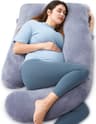
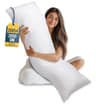
Three shapes are worth knowing. The straight I-shape (four of our five picks) is a plain 20-by-54 log: you hug it, one end goes between the knees, and it disappears when you fold it away. The U-shapewraps behind your back and comes around to your knees, so it supports both sides at once and you can turn over without repositioning it — at the cost of taking up a large fraction of the mattress. The J-shape is a U with one arm removed: a compromise sold mostly by maternity brands and, at the premium end, by clinical-positioning brands like MedCline, whose J-shaped pillow we looked at but did not rank because it publishes no material certification at roughly twice the price of anything here.
If you share a bed, measure before you buy a U. Fifty-seven inches of pillow arranged around one person is not a small object, and the most common reason a U-shape gets returned is not comfort — it is the other person in the bed.
3. Whether you can wash it
You sleep with your face against a body pillow. Over a year that is several hundred nights of skin contact on an object most people never think to clean, and the difference between a removable machine-washable cover and a spot-clean-only shell is a real one. Three of our five picks have covers that come off and go in the machine. The budget pick does not, which is the honest cost of its price.
Foam fills carry a second wrinkle: they arrive compressed and they smell of foam for a day or two. The firm pick’s own listing tells you to air it for 24 to 48 hours, which we would rather see than the silence most makers offer. That smell is the same phenomenon we cover in new mattress smell and off-gassing — smaller in scale, identical in mechanism, and worth planning around if you are sensitive to it.
4. What the maker will put in writing
This is where the category thins out, and it is why our order does not match a bestseller list. Of the five picks here, exactly one names a foam certification: Coop Home Goods states CertiPUR-US and GREENGUARD Gold on its listing, and our full review of it goes through what those two programs cover and the three specs that listing leaves blank. One more — the Momcozy U — carries Amazon’s sustainability badge naming OEKO-TEX STANDARD 100 for its textiles. The remaining three name nothing, and we record that as not published rather than assuming it either way.
The three marks are not interchangeable. CertiPUR-US tests flexible polyurethane foam for restricted substances, low emissions and restricted flame retardants — the foam only, not the cover, not the finished pillow. GREENGUARD Gold is an emissions standard, limiting what a product releases into room air against thresholds written for schools and healthcare settings. OEKO-TEX STANDARD 100 is a textile standard: it covers fabric submitted for testing, which on a pillow means the cover rather than what is inside it. Our certification decoder sets out what each one audits and, more usefully, what none of them touch.
How much weight to give this is yours to decide. A body pillow is a large volume of foam or fiber pressed against your face for eight hours a night, which is a higher-contact case than a mattress under a sheet. This site exists for readers who filter on what a thing is made of before they filter on price, so when one product in a category will document its foam and three will not, we are not going to bury it.
How to use one so it actually helps
The goal is a straight line from your shoulder through your hip to your knee, seen from above. Not a diagonal. Three adjustments get most people there.
Start at the knee, not the arm.Slide the pillow up until the section under your top knee is thick enough that the knee sits level with the hip — no higher. Everything above that point is arm support and is a bonus, not the purpose. If the pillow is too thick to get the knee level, take fill out (on the adjustable picks) or accept that you bought the wrong firmness.
Do not let it roll you forward. The failure mode of a body pillow is drifting from side sleeping into a half-stomach position over the pillow, which loads the lower back and turns the neck. If you wake face-down over the pillow with a stiff neck, the pillow is too thick, not too thin. Our guide to the best sleeping position for back pain covers what each position does to the spine, including why the half-turn is the one to avoid.
Re-check your head pillow afterward.Adding a body pillow changes how far your top shoulder rolls, and a head pillow that was the right loft before can be the wrong one after. If the neck gets worse as the back gets better, that is what happened — what pillow loft you actually need is the free half of the fix, and the side-sleeper neck pillow roundup is the paid half.
Body pillow, knee pillow, or neither
A contoured knee pillow does the leg half of this job better and for less money. It is shaped for the space between the knees, it stays strapped where you put it on the versions that have a strap, and it costs a fraction of a foam body pillow. If the only thing you need is your top knee held level, buy that instead — the picks are in our knee pillow roundup, and we would rather send you to the cheaper product that fits.
Buy the body pillow when the arm matters too: a sore shoulder that wants somewhere to rest, an upper back that gets pulled forward, or a habit of reaching an arm under the head, which is a reliable way to wake up with a numb hand. Buy it also if a knee pillow keeps ending up on the floor, because a five-foot pillow you are hugging does not migrate the way a small block does.
Buy neither if what you are treating is a bed that has stopped supporting you. The Cleveland Clinic lists an unsupportive mattress alongside sleep position among the usual causes of morning back pain, and no pillow outranks that. Run the two-minute check in how to fix a sagging mattress first. If the bed fails it, the honest next page is the best mattresses for side sleepers with back pain, or the cheaper interim step in side-sleeper mattress toppers. A body pillow on a sagging bed just holds a bent spine slightly straighter.
A note on price
These picks run from roughly the cost of a takeout meal to roughly the cost of a good head pillow. That is a wider spread than it looks, because the two ends are not the same product: the cheap end is fiber fill that compresses under a leg, and the expensive end is foam that does not. If you are buying for comfort, the cheap one is fine. If you are buying because your hip aches by morning, the fill is the thing you are paying for and skimping on it defeats the purchase.
What the money buys above that is optionality and documentation — a firmness you can change after the fact, a cover you can wash, and certifications you can look up on the certifier’s own site. Prices on this page are pulled live and dated; where one cannot be verified the button says “check price” rather than showing you a number that has gone stale. If you want the powered version of the same idea — support held under both legs all night without anything to reposition — that is an adjustable base, at roughly twenty times the price, and our wedge pillow roundup is the middle ground between the two.