How To Sleep With Spinal Stenosis
One clue in the symptom list tells you everything about which position to try: the pain eases when you lean forward. Here is how to build that into a bed.
How this is funded: we earn an Amazon commission if you buy through our links, at no extra cost to you. It never changes which product we recommend, and we’ll tell you plainly when to skip one. Full disclosure.
Of all the conditions on this site, spinal stenosis is the one where the symptom list hands you the answer. The Cleveland Clinic describes lumbar stenosis pain as worsening when you stand for long periods, walk, or walk downhill — and lessening when you lean forward, walk uphill, or sit. That is one pattern described four ways: the canal has less room than it should, and bending forward is what gives it room.
Which means the goal in bed is not comfort in the abstract. It is to hold a gently flexed lower back for six to eight hours without having to think about it. Everything below is a way of doing that cheaply.
What stenosis is, in one paragraph
Spinal stenosis is the narrowing of one or more spaces inside the spinal canal — the tunnel running through the vertebrae that carries the spinal cord. Less space means the cord and the nerve roots branching off it can be irritated, compressed or pinched, which is why the pain is so often felt somewhere other than the back. It is most common in people over 50, and the Clinic notes degenerative spinal changes affect up to 95% of people by that age. The two usual sites are the lower back and the neck, and they produce different problems: lumbar stenosis gives low back pain, pain running from the buttocks down the leg, heavy or cramping legs and pins and needles in the buttock, leg or foot, while cervical stenosis can give neck pain, numbness or tingling in an arm or hand, weakness or clumsiness, and balance problems.
Note what that paragraph does not contain: anything about mattresses. The Clinic's page says nothing about beds, and we are not going to pretend otherwise. The position reasoning below is ours, built on the one mechanical fact the Clinic does publish — that leaning forward relieves it.
The positions, best first
1. On your side, knees drawn up
This is the one to try tonight. A physical therapist writing for the Cleveland Clinic notes that the curled side-lying position can help specifically when the cause of the pain is spinal stenosis, and it is easy to see why: drawing the knees toward the chest flexes the lumbar spine, which is the posture that eases the pain when you are upright. The problem is maintaining it. Left alone, the top leg slides forward and drags the pelvis with it, which twists the lower back and undoes the flexion — the Clinic's general side-sleeping advice is to put a pillow between the legs to stop exactly that.
2. On your back, knees supported
If side sleeping is not available to you — a painful shoulder or hip, a CPAP, habit — back sleeping works, but only with something under the knees. Flat on a mattress, the legs straighten and the lower back arches into extension, which is the direction that narrows the canal. The Clinic's own guidance for back sleeping is a small pillow under the knees so the lower back does not over-arch. Raise the knees and the pelvis tilts, the lumbar curve flattens slightly, and you are back in flexion.
3. Inclined, head and knees both raised
The position an adjustable base produces, and the one many people with lumbar stenosis find easiest: torso raised a little, knees raised a little, lower back supported in between. You do not need a motorised bed to find out whether it suits you. A wedge under the torso plus a bolster or ramp under the knees reproduces most of it for a fraction of the cost, and if that combination is the thing that gets you through the night, our adjustable base picks are the permanent version.
4. What to avoid
Stomach sleeping, mostly. It extends the lower back — the opposite of what relieves stenosis — and it holds the neck rotated for hours, which matters a great deal if the narrowing is cervical. The Clinic notes stomach sleeping is generally discouraged while allowing that a few people find it relieving; if that is you, a thin pillow under the hips takes some of the extension out. Our stomach-sleeper pillow picks cover the low-loft options that keep the neck closer to neutral.
Which object does which job
| Position | What you are trying to do | What holds it |
|---|---|---|
| Side, curled | Flex the lumbar spine; stop the pelvis rotating forward | A contoured knee pillow between the knees |
| Back, knees up | Stop the lower back arching into extension | A half-moon bolster or a leg-elevation ramp under the knees |
| Inclined | Hold a seated-like flexed position all night | A wedge under the torso, ideally with a tunable height |
| Any position, cervical stenosis | Keep the neck in line rather than bent or rotated | A pillow at the correct loft for your position and mattress |
What to put under your knees
Four registry picks for the positions above, cheapest first — because the cheap ones are the ones to try before you change anything expensive. Each one holds a specific position; none of them treats stenosis.

ComfiLife Orthopedic Knee and Leg Pillow
Side sleepers who want the category standard at the lowest sensible price
For the curled side-lying position: a compact high-density foam contour that keeps the knees apart so the top leg stops dragging the pelvis forward. It is the cheapest thing in this guide and the one we would try first. Its listing names no foam certification, which we treat as not published.
$24.95 · See it on AmazonSee the knee pillowsPrice as of October 21, 2026. #ad How we’re funded
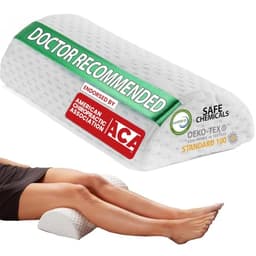
ComfiLife Half Moon Bolster Pillow
Back sleepers whose lower back aches from lying flat
For back sleeping: a 4-inch half-moon bolster that sits under the knees so the lower back cannot arch into extension all night. Lower and wider than a leg ramp, so it suits people who want a slight, sustained bend rather than real elevation.
$32.95 · See it on AmazonSee the picksPrice as of October 21, 2026. #ad How we’re funded
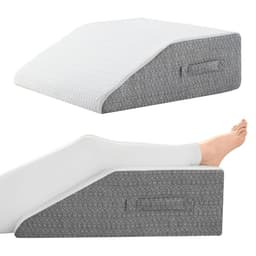
Nordjager Leg Elevation Pillow (8")
Back sleepers who want their legs raised rather than their torso
For more elevation than a bolster gives: an 8-inch firm ramp with a softer surface that raises the whole lower leg, flexing the hips and knees together. Use it when a small bend is not enough and a wedge under the torso is more than you want.
See the wedges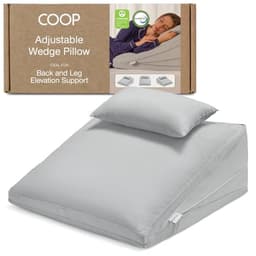
Coop Home Goods Adjustable Wedge Pillow
Anyone who does not already know what incline suits them
For testing the inclined position before buying an adjustable base: the only wedge we cover with stackable inserts, so you can change the angle instead of living with the one you bought. CertiPUR-US and GREENGUARD Gold are both published for it.
$99.00 · See it on AmazonSee the wedgesPrice as of October 21, 2026. #ad How we’re funded
The bed itself, and what the evidence does and does not say
There is no mattress research on spinal stenosis. What exists is research on chronic low-back pain generally, and it points at a firmness rather than a construction: the randomised double-blind trial in The Lancetfound medium-firm mattresses outperformed firm ones for pain and disability. The Cleveland Clinic's own mattress guidance says much the same and adds a useful buying tactic — start on the firmer side, because a topper can soften a bed but nothing can firm up a soft one.
For stenosis specifically we would add one criterion that no study covers: the surface has to let you holda flexed position. A bed so firm that your legs lie flat and your pelvis cannot tilt is working against the one posture that helps you, and a bed so soft that your hips sink below your shoulders arches the lower back in the other direction. If your current bed is sound and only the surface is wrong, a topper is the cheaper correction — our topper picks cover both directions, and mattress or topper helps decide which you actually need.
If disc degeneration is what led here — it is the most common route, since worn discs are one of the changes that narrows the canal — then the degenerative disc disease roundup is the bed page to read next. And if the pain runs down one leg, the sciatica picks and that position guide approach the same nerve from the symptom end.
Three things that are free
Get the pillow height right. It costs nothing if your pillow is adjustable, and it matters most if the narrowing is in your neck. The target is a neck in line with the spine rather than bent up or down; our loft diagnostic is five minutes.
Change the order of operations when you get up. Mornings are usually the worst part, because hours of stillness are not neutral. Rolling onto your side and pushing up with an arm, rather than sitting straight up out of flexion, is the standard advice and it costs nothing.
Stop troubleshooting two things at once.Change the knee support, give it a week, then change the pillow. People replace the mattress, the pillow and the position in the same week and end up unable to tell which one helped — and with a condition whose own pain comes and goes, that confusion is expensive.
General guidance, not medical advice. Pillow & Post is written by an enthusiast, not a doctor or chiropractor. Back and joint pain can have serious causes — if yours is severe, persistent, or comes with numbness or weakness, see a qualified professional. A mattress is one piece of the picture, not a treatment.
Frequently asked questions
What is the best sleeping position for spinal stenosis?
Most people with lumbar stenosis do best in a flexed position: on your side with the knees drawn up, or on your back with a pillow under the knees. The reason is in the Cleveland Clinic's own symptom list — stenosis pain lessens when you lean forward and worsens when you stand or walk — and both of those sleeping positions put the lumbar spine into the same gentle forward bend. A physical therapist writing for the Clinic notes the curled side-lying position can help specifically when the cause is spinal stenosis.
Why does spinal stenosis hurt less when I lean forward?
Because the symptoms come from narrowing of the spinal canal, and leaning forward is the posture that gives the canal and the nerve roots the most room. The Cleveland Clinic lists exactly this pattern: pain that worsens when you stand for long periods, walk, or walk downhill, and lessens when you lean forward, walk uphill or sit. It is the most useful diagnostic clue in the whole list, and it is what makes bedding a real lever.
Should I sleep on my stomach with spinal stenosis?
Usually not. Stomach sleeping extends the lower back — the opposite of the flexed position that relieves stenosis — and it also forces the neck into rotation for hours, which matters if the narrowing is in your neck. The Cleveland Clinic notes stomach sleeping is generally discouraged while acknowledging a few people genuinely find it relieving; if you are one of them, a thin pillow under the hips reduces the extension.
Is a firm or soft mattress better for spinal stenosis?
There is no stenosis-specific mattress research, and we will not invent any. The general back-pain evidence points at medium-firm: the Lancet trial found medium-firm outperformed firm for chronic low-back pain and disability. What matters more for stenosis is whether the surface lets you hold a flexed position comfortably — a bed so firm it forces your legs flat works against the position that helps you.
Does an adjustable bed help spinal stenosis?
It can, because raising the head and the knees holds exactly the flexed position that tends to relieve lumbar stenosis, all night, without you having to maintain it. The Cleveland Clinic notes adjustable models give a lot of control but tend to be pricey — so test the position with a wedge and a knee bolster first. If those help, a base is buying convenience rather than a new effect.
How should I sleep with cervical spinal stenosis?
The lever is the pillow, not the legs. Cervical stenosis symptoms can include neck pain, numbness or tingling in an arm, hand, leg or foot, weakness or clumsiness in the hands, and balance problems. The bedding aim is a loft that keeps the neck in line with the spine rather than bent up, down or sideways, and avoiding stomach sleeping with the head turned.
Why is my spinal stenosis pain worse in the morning?
Often because of the hours of stillness rather than the bed itself. A position you would not hold for two minutes awake is one you can hold for six hours asleep, and that is the usual cause of a stiff first hour. If mornings are your worst time, the two things to change are the knee support and whether the bed lets your hips drop below your shoulders.
When should I see a doctor instead of changing my bedding?
Numbness, tingling, weakness or clumsiness in a limb, balance problems, or any change in bowel or bladder control are medical questions, not bedding questions. Spinal stenosis is a structural narrowing — nothing in this guide treats it. Everything here is about not making a provoked nerve hold a bad position for eight hours.
Sources
- Cleveland Clinic — Spinal Stenosis: Symptoms, Causes & Treatment — Spinal stenosis is narrowing of one or more spaces within the spinal canal, which can irritate, compress or pinch the spinal cord and the nerve roots branching off it; it is most common in people over 50, and degenerative spinal changes affect up to 95% of people by that age. The two usual sites are the lower back and the neck. Lumbar symptoms include low back pain, pain beginning in the buttocks and extending down the leg, a heavy feeling or cramping in the legs and numbness or tingling, with pain that WORSENS on standing for long periods, walking or walking downhill and LESSENS when leaning forward, walking uphill or sitting. Cervical symptoms include neck pain, numbness or tingling in an arm, hand, leg or foot, weakness or clumsiness and balance problems. Contains no information about mattresses, pillows or sleeping positions (accessed October 17, 2026)
- Cleveland Clinic — How To Get Better Sleep With Sciatica Pain (physical therapist Cara Sieberth, PT; August 2025) — Back sleeping promotes spinal alignment; side sleeping on the side opposite the pain relieves pressure on the nerve, with a pillow between the knees; the curled side-lying position can help when the cause is spinal stenosis; stomach sleeping is generally discouraged but relieves a few people. Cites a review finding a medium-firm mattress best for lower-back pain (accessed September 18, 2026)
- Cleveland Clinic — Best Sleeping Positions for Pain — Back sleeping puts least pressure on the spine, with a small pillow UNDER the knees so the lower back does not over-arch; side sleepers put a pillow BETWEEN the legs to stop the top leg pulling forward and twisting the torso (accessed August 12, 2026)
- Cleveland Clinic — How To Choose a Mattress for Better Sleep (chiropractor Andrew Bang, DC; May 2023) — Recommends a medium-firm mattress and starting on the firmer side so a topper can adjust it; notes adjustable models give a lot of control to meet changing needs but tend to be pricey; suggests replacing a mattress around every 10 years and checking the return policy before buying (accessed September 18, 2026)
- Kovacs et al. — Effect of firmness of mattress on chronic non-specific low-back pain (The Lancet, 2003) — Randomized double-blind trial (n=313): medium-firm mattresses outperformed firm for low-back pain and disability (accessed July 23, 2026)
Keep reading
Best mattresses for degenerative disc disease
Disc degeneration is the most common route into stenosis — the beds ranked on steady support.
See the picksHow to sleep with sciatica
The radiating-leg symptom stenosis often produces, with its own position rules.
Read the guideBest knee pillows for back and hip pain
The object that holds the curl without effort, and the cheapest thing on this site.
See the picksBest wedge pillows
How to test an inclined, flexed position before spending on an adjustable base.
See the wedges