Is My Pillow Too High or Too Low?
Both faults produce a sore neck by morning, so the symptom alone will not tell you which way to move. Four checks that will.
How this is funded: we earn an Amazon commission if you buy through our links, at no extra cost to you. It never changes which product we recommend, and we’ll tell you plainly when to skip one. Full disclosure.
Here is the problem with this question: both faults feel the same at 7am. A pillow that is too tall and a pillow that is too short both produce a sore, stiff neck, both get blamed on “sleeping funny”, and both get replaced with another pillow chosen the same way the last one was. The useful information is not that your neck hurts. It is where it hurts, and what you can see in a mirror.
The target is simple and comes from the Cleveland Clinic: pillow height should keep the neck parallel to the mattress rather than bent up or down. Everything below is a way of finding out which side of that line you are on.
The symptom map
| What you wake with | Most likely | Why |
|---|---|---|
| Tightness at the front and base of the neck; stiff swallow; ache under the jaw | Too high | The chin is held toward the chest for hours, shortening the front of the neck |
| Dull headache from the base of the skull, radiating forward | Too high | Sustained flexion loads the joints and muscles at the top of the neck |
| Pain on the top of the shoulder and the side of the neck, same side each time | Too low | The head drops, so the muscles on the upper side are stretched all night |
| A dead or tingling arm | Too low | Side-bending the neck and compressing the shoulder underneath you |
| You keep stuffing an arm under the pillow in the night | Too low | You are adding loft in your sleep, which is the body solving it for you |
| You wake having pushed the pillow away or folded it | Either | Folding adds height, pushing it out removes it — note which you did |
That last row is the most underrated diagnostic in this guide. What you do to a pillow while unconscious is an unbiased vote about which direction it is wrong.
The mirror test, which takes two minutes
Put a mirror on a chair beside the bed, or have someone take a photo of you from the front, and lie down in the position you actually sleep in — not the one you think you should. Then look at three things.
On your side: is the line from the middle of your forehead down through your nose and chin parallel to the mattress, or tilted? Tilt toward the mattress means too low. Tilt away from it means too high.
On your back: is your chin level, or pushed down toward your chest? A chin tucked at rest means the pillow is taller than the gap behind your neck, which is the most common error of all because that gap is shallow.
Either position: is the pillow under your head only, with the neck unsupported and bridging a gap? That is a loft problem and a shape problem at once, and it is the case a contoured pillow exists for.
The variable nobody accounts for: your mattress
The Cleveland Clinic's pillow guidance contains a clause most people skip — the right pillow thickness depends on how firm your mattress is, because a firmer bed needs a thicker pillow and a softer bed a thinner one. The mechanism is easy to picture: on a soft bed your shoulder sinks in, which closes part of the gap your pillow would otherwise have to fill, while a firm bed holds the shoulder up and leaves the whole gap open.
Two consequences follow, and both explain things people find mysterious. First, a pillow that was perfect can become wrong without changing at all — you bought a new mattress, or the old one softened. Second, adding a topper changes the loft you need, which is why a new topper so often produces a new neck ache a fortnight later. If that is your situation, start with the firmness guide and then re-run the mirror test rather than buying a third pillow.
Correct in one direction, then wait
Change the loft only. Keep the mattress, the position and the room the same, and give it several nights, because a neck that has been held flexed for years will protest a neutral position at first. This is the single most common reason a correct pillow gets returned in week one. Judge after a week; abandon immediately only if it is painful on night one.
How to change it depends on what you own. A shredded-fill pillow is adjusted by removing fill — start by taking out a double handful rather than a pinch, since most people are further from right than they expect. A one-piece contour cannot be adjusted at all, which is why the mirror test belongs before you buy one. A fiber pillow folded in half is a crude way to test whether more height helps, and if it does, that is evidence rather than a solution.
Correcting in each direction
Four registry picks: two that let you tune the loft after you buy, one for when the answer is clearly 'much lower', and one for when it is clearly 'much higher on my side'. Run the mirror test first — the point of this list is that you already know which way you are wrong.

Coop Home Goods Original Adjustable Pillow
Anyone unsure of their loft, or who changes position through the night
The answer when you do not know your number: cross-cut shredded fill in a zippered liner, so you remove or add foam until the mirror test passes instead of exchanging the pillow. CertiPUR-US and GREENGUARD Gold are both published for the fill. It needs occasional fluffing to hold the height you set.
$89.00 · See it on AmazonSee the adjustable picksPrice as of October 21, 2026. #ad How we’re funded

QUTOOL Cooling Adjustable Shredded Memory Foam Pillow (Queen, 2-pack)
Buying a certified-foam pillow for the guest room, or testing adjustable loft cheaply
The same adjustable mechanism at the lowest price we cover, sold as a queen pair — which is genuinely useful here, because it lets you set two different lofts and sleep on each for a few nights rather than guessing once. CertiPUR-US named for the foam.
See the adjustable picks
Bluewave Bedding Ultra Slim Gel Memory Foam Pillow (2.75")
Back and stomach sleepers whose neck hurts because their pillow is too tall
When the verdict is clearly 'too high': a published 2.75-inch gel memory foam slab, which is one of very few pillows that states its loft in inches at all. Back sleepers and anyone whose chin was tucked in the mirror test should start here rather than guessing at a 'low-profile' pillow with no number.
See the thin pillows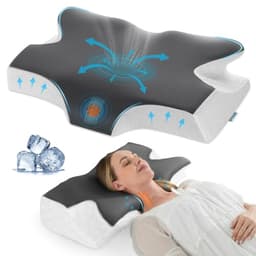
Elviros Cervical Memory Foam Pillow (Cooling)
Side sleepers whose neck kinks on a flat pillow
When the verdict is clearly 'too low and I sleep on my side': a dual-height contour with cutouts that give the shoulder somewhere to go, so the taller lobe fills the gap without levering the shoulder up. Fixed shape, so it is the right buy only once you know the direction. CertiPUR-US named for the foam; no loft in inches published.
See the side-sleeper picks
When it is not the pillow
Three cases, worth ruling out before you buy anything.
You sleep on your stomach with your head turned.No loft fixes that geometry — the Cleveland Clinic warns against it specifically. The answer is the thinnest pillow you can tolerate, or none, plus a thin pillow under the hips; our stomach-sleeper picks cover the sub-3-inch field.
The pillow is finished. A fill that has compressed is a loft that has changed, which means your pillow may have been right and is now too low. Our replacement guide has the tests.
It is a nerve, not a muscle.Numbness, tingling, weakness or loss of coordination in an arm, pain after an accident, or pain with fever or unexplained weight loss are on the Cleveland Clinic's list of reasons to seek care promptly. A pillow is a mechanical lever on position, not a treatment — if the loft is right and the symptom persists, stop shopping and get it looked at.
General guidance, not medical advice. Pillow & Post is written by an enthusiast, not a doctor or chiropractor. Back and joint pain can have serious causes — if yours is severe, persistent, or comes with numbness or weakness, see a qualified professional. A mattress is one piece of the picture, not a treatment.
Frequently asked questions
How do I know if my pillow is too high?
The giveaway is where the pain is: a pillow that is too tall holds the chin toward the chest, so you wake with tightness at the front and base of the neck, sometimes a stiff swallow or an ache under the jaw, and often a dull headache from the back of the skull. In a mirror you will see the chin tucked and the head pushed forward of the spine. Back sleepers get this wrong far more often than side sleepers, because the gap behind a lying head is shallow.
How do I know if my pillow is too low?
The head drops, so the neck bends toward the mattress and the muscles on the upper side are stretched all night. You wake with pain on the top of the shoulder and the side of the neck, often on the same side every time, and frequently with a dead or tingling arm. Side sleepers get this wrong most, because the gap a shoulder makes is several inches deep and most pillows are not built for it.
What is the correct pillow height?
There is no single number, and that is not evasion. The Cleveland Clinic's guidance is that pillow height should keep your neck parallel to the mattress rather than bent up or down — and that the right thickness depends on how firm your mattress is, because a firmer bed needs a thicker pillow and a softer bed a thinner one. Your shoulder width and sleeping position set the rest.
Can the wrong pillow height cause a headache?
Neck mechanics and head pain are linked: a cervicogenic headache is head pain referred from a neck problem, typically starting at the base of the skull and radiating forward, and the Cleveland Clinic lists sleeping on a supportive pillow and mattress among the prevention strategies for it. That is not a promise that a pillow fixes a headache, but a chin held on the chest for eight hours is a plausible provocation.
Why does my arm go numb at night?
Commonly because the shoulder is compressed or the neck is held side-bent — a pillow too low for a side sleeper does both. Change the loft first, because it is free to test. But numbness, tingling, weakness or loss of coordination in an arm is also on the Cleveland Clinic's list of reasons to seek care promptly, so if it persists after the loft is right, that is a medical question rather than a bedding one.
Should a side sleeper use a higher or lower pillow?
Higher, usually much higher than people expect — the gap between a side sleeper's head and the mattress is as deep as the shoulder is wide. Back sleepers need a lower loft because the space behind the neck is shallow. Stomach sleepers need the thinnest pillow available, or none; the Cleveland Clinic warns against sleeping on the stomach with the head turned at all.
Is it better to have a pillow that is slightly too high or too low?
Neither is comfortable, but a slightly low pillow is usually the easier error to live with on a soft mattress, because the bed closes some of the gap for you. On a firm mattress, slightly low is the worse error for the same reason. If you do not know, an adjustable fill removes the guess — you take fill out rather than returning the pillow.
How long before I know whether a new pillow height is right?
Several nights. A neck that has spent years held in one position protests a correct position at first, which is the usual reason a good pillow gets returned in week one. Change one variable, keep the mattress and position constant, and judge after a week — unless it is obviously, painfully wrong on night one, in which case move on.
Sources
- Cleveland Clinic — Is Your Pillow Giving You a Stiff Neck While You Sleep? — Pillow height should keep the neck parallel to the mattress rather than bent up or down, and the right thickness depends on mattress firmness — a firmer bed needs a thicker pillow, a softer bed a thinner one (accessed August 12, 2026)
- Cleveland Clinic — Neck Pain: 6 Common Causes and Treatments — Advises that back and side sleepers use a pillow that keeps the head and neck aligned, and warns against sleeping on the stomach with the head turned. Names numbness or tingling in the arms, weakness or loss of coordination, pain after an accident, and pain with fever or unexplained weight loss as reasons to seek care promptly (accessed September 18, 2026)
- Cleveland Clinic — Best Sleeping Positions for Pain — Back sleeping puts least pressure on the spine, with a small pillow UNDER the knees so the lower back does not over-arch; side sleepers put a pillow BETWEEN the legs to stop the top leg pulling forward and twisting the torso (accessed August 12, 2026)
- CertiPUR-US — Frequently Asked Questions — CertiPUR-US certifies the flexible polyurethane foam only, not the whole mattress, and does not address fiberglass fire barriers (accessed July 23, 2026)
Keep reading
Pillow loft for neck pain
Once you know which direction to move, this is the loft-by-position guide to move with.
Read the guideBest adjustable pillows
The pillows you correct by the handful instead of exchanging — the lowest-risk buy when you are unsure.
See the picksBest pillows for neck pain (side sleepers)
Where too-low is the usual error, because the gap is as deep as your shoulder is wide.
See the picksPillows for neck pain with arm numbness
The symptom that most often means the loft is wrong — and when it means something else.
See the picks