Do I Need a Mattress Protector?
Usually yes, and the reason is less about hygiene than about the clause in your warranty. Here are the four cases where it earns its money, and the cases where it does not.
How this is funded: we earn an Amazon commission if you buy through our links, at no extra cost to you. It never changes which product we recommend, and we’ll tell you plainly when to skip one. Full disclosure.
The short answer
Usually yes — and the strongest argument for it is not hygiene, which is what protectors are sold on. It is the warranty.
Mattress warranties are written documents with exclusions in them, and a stain or soiling exclusion is close to universal. Under the Magnuson-Moss Warranty Act a written warranty on a consumer product has to disclose its terms and conditions in plain language and be designated full or limited — which is why that clause is printed rather than assumed. The practical effect is that a visibly stained mattress is the easiest claim in the world for a manufacturer to decline, regardless of whether the stain has anything to do with the sagging you are claiming for. A protector costs a small fraction of the bed and keeps you on the right side of it for the whole warranty term.
Which leads to the test that actually decides this for you: does your mattress have a warranty at all?Several beds we cover publish no warranty term on the listing — the Novilla hybrid and the Cotton Sleep organic bed among them — and a couple publish no trial either. If there is nothing to protect, the insurance argument evaporates and the decision rests on the other three cases below. Our warranties and sleep trials guide explains why those two things get confused and why neither implies the other.
The four cases where the answer is yes
1. The bed has a warranty you might one day use.As above. This is the case that applies to most people and the one nobody mentions in protector marketing, probably because “insurance against a contract clause” is a worse headline than “sleep clean”.
2. Children, or anyone still having accidents.A mattress cannot be laundered and a foam core that has been soaked is, practically speaking, finished — you cannot dry the inside of it and you cannot wash it. This is the case where a protector is not an optimization but the difference between one accident and one new mattress. It applies as much to a child’s twin as to an adult bed; see our kids’ mattress picks, none of which can survive what a protector would have prevented.
3. Allergies, or anyone who reacts to dust.A zipped or fitted barrier between you and the mattress reduces what accumulates in the surface you breathe over. We are not going to quantify that for you — we have no study to cite and are not going to invent one — but the mechanism is not controversial and the cost is low.
4. You intend to keep the bed a long time. A mattress is typically replaced on a timescale of years, and the surface ages with everything that lands on it. If you plan to get a decade out of a bed, a protector is the cheapest thing you can do about the one layer you cannot replace. Our how often to replace a mattress guide covers what the published guidance actually says about that timescale.
When it is genuinely optional
Three honest exceptions, because a page that says “everyone needs one” is advertising rather than advice.
Your mattress publishes no warranty and no trial. The insurance argument is gone. If you also have no children, no pets and no allergies, a protector is a preference.
You will not tolerate the feel or the noise. A waterproof layer is a membrane, and a membrane is less breathable than a sheet. If you sleep hot or you are sensitive to a crinkle, the realistic outcome of buying a cheap laminated protector is that it spends a year in a cupboard. Buy a quiet one or do not buy one.
Your bed already has a washable cover.A few beds — and most of the kids’ twins we cover — have removable machine-washable covers, which handles spills that have not soaked through. It does not handle the ones that have, and it does not satisfy a stain clause once the core is marked, but it narrows the gap.
What to look for, in priority order
Genuinely waterproof, not water-resistant. These are different claims and only one of them survives a full glass of water.
Quiet. The most under-rated spec in the category. Two of the three protectors we cover describe their construction as noiseless.
A surface you want against you.A protector sits between you and everything else, all night, every night — which makes the textile certification the whole story rather than a footnote. OEKO-TEX STANDARD 100 tests every submitted component against more than a thousand harmful substances, with stricter limits the closer a fabric sits to skin. GOTS is the whole-textile organic standard. Both are a different kind of claim from “natural”.
Pocket depth that matches your bed. This one catches people out in both directions. A 15-inch pocket will not stretch over a thick hybrid plus a 4-inch topper; a 20-inch pocket on a thin twin leaves a bag of loose fabric that rucks up under the sheet. Measure the bed, including any topper, and buy to that.
The three protectors we cover
All three are queen listings and all three are waterproof; they differ on which textile standard they carry, on whether they add any padding, and on how deep a bed they fit. Buy the size and depth that matches your own mattress.
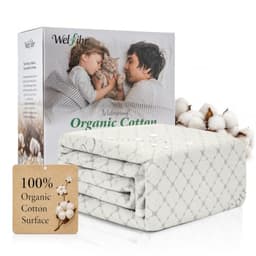
Welfibr Organic Cotton Surface Waterproof Mattress Protector (Queen)
The certified default — quiet, breathable, and cheap enough that skipping a protector makes no sense
The certified default: surface stated as 100% organic cotton over a TPU membrane the listing describes as noiseless, OEKO-TEX Standard 100 certified, 15-inch pockets, machine washable and tumble dryable without losing the waterproofing. The cheapest of the three.
$38.99 · See it on AmazonSee the roundupPrice as of October 22, 2026. #ad How we’re funded
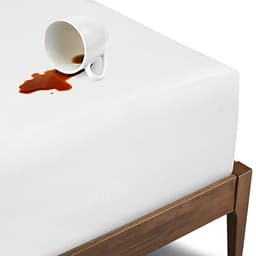
Bioweaves Organic Waterproof Mattress Protector (Queen)
Anyone who wants a certified-organic cotton surface and will pay for it
The only one carrying GOTS — a whole-textile organic standard rather than a substances test — on the layer against your skin, with 20-inch deep pockets that fit a thick hybrid plus a topper. The waterproof back layer is synthetic and the listing says so plainly.
$69.00 · See it on AmazonSee the roundupPrice as of October 22, 2026. #ad How we’re funded
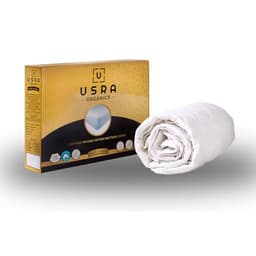
USRA Quilted Waterproof Cotton Protector (Queen)
Anyone who wants a padded, cotton-filled protector that softens the surface slightly
A quilted 300 GSM cotton pad rather than a thin membrane sheet, so it adds a little cushioning as well as a barrier — and the only one publishing its actual OEKO-TEX certificate number, which turns a badge into something you can check.
$69.99 · See it on AmazonSee the roundupPrice as of October 22, 2026. #ad How we’re funded
What a protector cannot do
It will not change how your bed feels. If your complaint is that the mattress is too firm or too soft, a protector is the wrong object entirely and even a quilted one only takes the hard edge off. The object that changes feel is a topper, and mattress pad vs mattress topper sorts out which of the three products you actually want.
It will not fix a sagging bed. Nothing thin can. See how to fix a sagging mattress.
It will not contain fiberglass.The federal open-flame rule applies to mattresses and mattress sets, and where a maker meets it with a woven glass-fiber barrier, that barrier sits inside the mattress cover — a protector laid over the top does not seal a seam and does not retrieve fibers that have already escaped. We have a whole page on what a protector can and cannot do about fiberglass, because it is the most common wishful purchase here.
General guidance, not medical advice. Pillow & Post is written by an enthusiast, not a doctor or chiropractor. Back and joint pain can have serious causes — if yours is severe, persistent, or comes with numbness or weakness, see a qualified professional. A mattress is one piece of the picture, not a treatment.
Frequently asked questions
Do I really need a mattress protector?
If your mattress has a warranty, yes — treat it as the premium on that warranty, because stain and soiling exclusions are standard and a visibly stained mattress is the easiest claim for a manufacturer to decline. If your mattress publishes no warranty at all, which several beds we cover do not, the warranty argument disappears and the decision comes down to allergens, children, pets and resale.
Does a mattress protector void or protect a warranty?
It protects one. Under the Magnuson-Moss Warranty Act a written warranty on a consumer product has to disclose its terms and conditions in plain language and be designated full or limited, which is exactly why the stain exclusion is written down rather than implied — read your own and you will usually find it. A protector is how you stay on the right side of that clause for ten years.
Is a mattress protector the same as a mattress pad or a topper?
No, and the three get used interchangeably in product titles. A protector is a thin barrier against liquid and allergens that changes nothing about how the bed feels. A pad adds a small amount of quilted cushioning. A topper is two to four inches of foam or latex that deliberately changes the feel and the support of the bed. One of our picks is genuinely both a protector and a thin pad, which is why that distinction is worth stating.
Do mattress protectors make you sleep hot?
A waterproof one can, because the waterproofing is a membrane and a membrane is less breathable than a sheet. How much depends on the construction: a TPU membrane under an organic cotton surface sleeps cooler than a vinyl laminate, and a quilted cotton pad breathes better still but is thicker. This is the real cost of a protector and the reason people abandon them, along with noise.
Are mattress protectors noisy?
Cheap laminated ones are, and that crinkle is the single most common reason a protector ends up in a cupboard. Two of the three we cover describe their construction as noiseless — one with a TPU membrane, one quilted — and it is worth prioritizing, because a protector you remove is a protector that is not working.
Will a mattress protector stop fiberglass?
Not in the way people hope. A protector is a barrier on top of the mattress against liquid and allergens; it does not seal a cover seam and it does not contain fibers that have already escaped a damaged cover. We wrote a separate page on this because it is the most common wishful purchase in the category.
What should I look for in a mattress protector?
Four things, in this order: that it is genuinely waterproof rather than water-resistant; that it is quiet; that the surface against you is a fabric you want against you rather than polyester over plastic; and that the pocket depth actually fits your bed, which matters more than people expect — a 20-inch pocket on a 6-inch mattress leaves a bag of fabric under the sheet.
How often should you wash a mattress protector?
As often as you wash sheets is a reasonable default, and more often after an accident. The more useful question is whether it survives it: the protectors we cover state machine washing and tumble drying without loss of waterproofing, which is the spec that decides whether you still own a working protector in year three.
Sources
- FTC — Businessperson's Guide to Federal Warranty Law — Under the Magnuson-Moss Warranty Act a written warranty on a consumer product must disclose its terms and conditions in plain language and be designated 'full' or 'limited'; the FTC sets the standards a 'full' warranty must meet (accessed August 19, 2026)
- OEKO-TEX — STANDARD 100 — Textile-safety label: every submitted component tested against 1,000+ harmful substances, with stricter limits the closer the fabric is to skin (accessed July 23, 2026)
- GOTS — Certification & Labeling — Global Organic Textile Standard: whole-product organic-fiber certification (≥70% organic fibers), restricted inputs, and prohibits synthetic/fiberglass fire barriers (accessed July 23, 2026)
- CPSC — Mattresses, Mattress Pads & Mattress Sets (business guidance) — Mattresses sold in the US must meet the federal open-flame standard at 16 CFR Part 1633, which limits the size of the fire a mattress set produces in a 30-minute test — a performance requirement that does not specify which fire-barrier material a maker uses to meet it (accessed August 19, 2026)
Keep reading
How often to replace a mattress protector
Once you own one: the water-bead test, and replacing it while the warranty still matters.
Read the guideBest non-toxic mattress protectors
The three certified protectors we cover, ranked on which textile standard each one carries.
See the picksMattress pad vs mattress topper
Three products get called the same thing. Which one you actually want, by symptom.
Read the guideMattress warranties and sleep trials
Why the two are not interchangeable, and what a limited warranty usually excludes.
Read the guideCan a protector stop fiberglass?
The job people buy a protector for that it does not do.
Read the guide