Will a Mattress Protector Stop Fiberglass?
The short answer is no — not the kind most people own. Here is what a fitted protector actually blocks, what a full encasement does differently, and why neither is the fix people hope for.
How this is funded: we earn an Amazon commission if you buy through our links, at no extra cost to you. It never changes which product we recommend, and we’ll tell you plainly when to skip one. Full disclosure.
The short answer
No, and the reason is shape rather than fabric. The thing almost everyone owns is a fittedprotector: a sheet with a thin waterproof membrane, held on by an elastic skirt, covering the top and the sides of the mattress and leaving the entire underside open. Fiberglass that escapes a mattress does not politely exit through the top. It comes out of the bottom panel, out of the seams along the edges, and out of the zipper itself — the three places a fitted protector does not reach.
A fully zippered encasementis a different product: it encloses all six faces of the mattress and is the shape used against bed bugs and dust-mite allergens. In principle it is the only kind of cover that could contain something coming from inside the bed. In practice we are not going to tell you it solves the problem, for a simple reason: there is no fiberglass-containment test, no standard, and no certification for this. A maker can print “blocks fiberglass” on a box and nobody audits it. The certifications we do trust — CertiPUR-US for foam content and emissions, OEKO-TEX STANDARD 100 for harmful substances in textiles — test for entirely different things and say nothing about whether a fabric retains glass fibers.
So the honest position is this. A protector is a good thing to own. It is not a fiberglass remedy, and anyone selling it to you as one is making a claim that cannot be checked.
Why fiberglass is in the bed in the first place
Mattresses sold in the US have to meet the federal open-flame standard at 16 CFR Part 1633, which limits the size of the fire a mattress set produces in a 30-minute test. It is a performance requirement. It does not tell a manufacturer which material to use, and that is the whole story: the maker picks whatever passes most cheaply. A woven fiberglass sock sitting directly under the cover is extremely cheap and extremely effective, which is why it is standard in inexpensive foam beds and essentially absent from the organic tier, where a wool layer does the same job at many times the cost.
While the sock stays inside the cover, it is doing its job and nothing else. The failure mode is specific and well documented in consumer complaints: the cover comes off — usually because it has a zipper and somebody unzipped it to wash it — or a seam splits, and the fibers get into the room. That is why so many of these beds carry a care tag telling you not to remove the cover. The warning is the tell. Our guide to spotting fiberglass goes through the label language in detail.
What a protector is genuinely for
Having ruled out the job people hope it does, here is the job it actually does, and it is worth doing. A protector keeps liquid out of the foam, which is what kills mattresses and voids warranties — nearly every warranty we read for our warranties and sleep trials guide excludes a stained mattress from coverage entirely, so the protector often pays for itself in warranty terms alone. It keeps sweat and skin cells out of the comfort layer, which is the dust-mite food supply. And it decides what fabric is actually against your skin for eight hours a night, which on a site about what sleep products are made of is not a footnote: the certified cotton surface of a good protector may be a better material than the mattress cover underneath it.
That last point is the one that matters most to the reader who arrived here worried about materials. You cannot change what is inside your mattress. You can change what touches you.
Protectors worth owning for what they actually do
Not fiberglass barriers — none of these claims to be, and we would not repeat the claim if they did. These are the three certified protectors we cover, ranked on the surface against your skin and on what each listing actually documents. All three are fitted, with elasticized skirts, not zippered encasements.
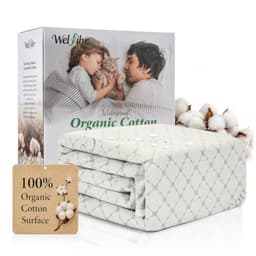
Welfibr Organic Cotton Surface Waterproof Mattress Protector (Queen)
The certified default — quiet, breathable, and cheap enough that skipping a protector makes no sense
The default. The surface is stated as 100% organic cotton over a TPU membrane kept underneath, certified to OEKO-TEX STANDARD 100, and the TPU backing is described as noiseless — the complaint that makes people abandon protectors. Cheap enough that skipping one makes no sense.
$37.99 · See it on AmazonSee the protector roundupPrice as of October 5, 2026. #ad How we’re funded
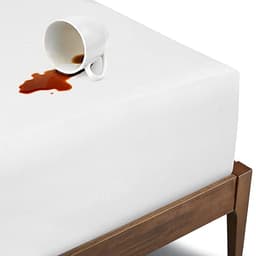
Bioweaves Organic Waterproof Mattress Protector (Queen)
Anyone who wants a certified-organic cotton surface and will pay for it
The only protector we cover carrying GOTS, a whole-textile organic standard, on the layer your skin touches — and candid that the waterproof layer beneath it is synthetic, which is true of every waterproof protector. Roughly twice the price of the OEKO-TEX options.
$69.00 · See it on AmazonSee the protector roundupPrice as of October 5, 2026. #ad How we’re funded
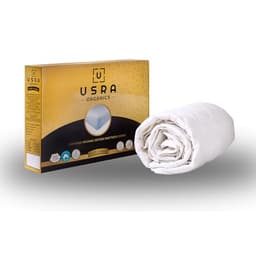
USRA Quilted Waterproof Cotton Protector (Queen)
Anyone who wants a padded, cotton-filled protector that softens the surface slightly
A quilted cotton pad rather than a thin membrane sheet, so it adds a little softness as well as a barrier — and the only listing here that publishes its actual OEKO-TEX certificate number, which turns a badge into something you can look up.
$69.99 · See it on AmazonSee the protector roundupPrice as of October 5, 2026. #ad How we’re funded
What to do if you think your mattress is shedding
We are not a remediation service and we will not pretend to be one. What we can set out is the order of operations that follows from the mechanism above. Stop removing the cover, and do not wash it — if the care tag says the cover is not removable, that instruction is the containment strategy. Do not vacuum with a household vacuum that recirculates its exhaust, because that redistributes fine fibers rather than removing them. Contact the manufacturer and ask directly what the fire barrier is made of; a maker who uses wool or a treated rayon knit will tell you quickly, and the quality of the answer is itself informative. If fibers have already escaped into the room, professional cleaning advice is beyond anything a buying guide can responsibly offer.
And when it comes to replacing the bed, the filter that actually works is upstream of any cover you put on it. Buy a mattress whose own listing states fiberglass-free construction — our fiberglass-free roundup collects the beds that do, and by budget shows what the claim costs at three price points. Better still, buy into the organic tier, where GOTS prohibits synthetic fire barriers outright and the claim stops depending on a maker’s sentence: our organic mattress explainer covers what GOTS and GOLS each certify, and the non-toxic back-pain roundup ranks the certified beds on support as well as materials.
The one-line version
A fitted protector covers five-sixths of nothing in this context; an encasement is the right shape but carries no verifiable containment claim; and the only reliable fix is a mattress that never had a fiberglass fire barrier in it. Buy the protector for spills, for the warranty, and for the fabric against your skin. Buy the next mattress on what its listing states about the barrier.
General guidance, not medical advice. Pillow & Post is written by an enthusiast, not a doctor or chiropractor. Back and joint pain can have serious causes — if yours is severe, persistent, or comes with numbness or weakness, see a qualified professional. A mattress is one piece of the picture, not a treatment.
Frequently asked questions
Will a mattress protector stop fiberglass?
A normal fitted protector will not. It covers the top and the sides and is open underneath, and fiberglass released from inside a mattress travels through the bottom panel, the seams and the zipper as much as through the top. A fully zippered encasement is a different product and encloses all six sides, but no mattress protector or encasement we have seen is tested or certified for fiberglass containment — that claim does not exist as a verifiable standard.
What is the difference between a mattress protector and an encasement?
A protector is a fitted sheet with a barrier layer: it covers the top and sides and holds on with an elastic skirt, leaving the underside of the mattress open. An encasement zips all the way around and encloses all six faces. Encasements are the category used against bed bugs and allergens, and they are the only shape that could plausibly contain anything coming from inside the bed.
Does my mattress have fiberglass?
Check the law tag and the care instructions. The two phrases to look for are a materials line naming glass fiber or 'glass wool', and a care instruction telling you not to remove the cover — that warning exists because of what is underneath it. A listing that states fiberglass-free construction in its own bullets is the positive version of the same answer.
Is fiberglass in a mattress dangerous if I leave the cover on?
The fire barrier is designed to stay inside the cover, and while it does, it is not shedding into your room. The failure mode is the cover coming off or splitting at a seam — which is why the care tag warns against removing it. We are not a medical or safety authority; what we can say is that the containment depends entirely on the cover staying intact.
Why do mattresses contain fiberglass at all?
US mattresses must meet the federal open-flame standard at 16 CFR Part 1633, which limits the size of fire a mattress produces in a 30-minute test. The rule sets a performance target and does not name a material, so the maker chooses how to pass it. A woven fiberglass sock is the cheapest way, which is why it shows up in inexpensive foam beds.
What should I buy instead?
A bed whose listing states fiberglass-free construction, or one in the organic tier where GOTS prohibits synthetic fire barriers outright, so the claim is enforced by a standard rather than asserted in a bullet. A protector is still worth owning — for spills, dust and the surface against your skin — but buy it for those reasons, not as a containment device.
Sources
- CPSC — Mattresses, Mattress Pads & Mattress Sets (business guidance) — Mattresses sold in the US must meet the federal open-flame standard at 16 CFR Part 1633, which limits the size of the fire a mattress set produces in a 30-minute test — a performance requirement that does not specify which fire-barrier material a maker uses to meet it (accessed August 19, 2026)
- CertiPUR-US — Frequently Asked Questions — CertiPUR-US certifies the flexible polyurethane foam only, not the whole mattress, and does not address fiberglass fire barriers (accessed July 23, 2026)
- OEKO-TEX — STANDARD 100 — Textile-safety label: every submitted component tested against 1,000+ harmful substances, with stricter limits the closer the fabric is to skin (accessed July 23, 2026)
- GOTS — Certification & Labeling — Global Organic Textile Standard: whole-product organic-fiber certification (≥70% organic fibers), restricted inputs, and prohibits synthetic/fiberglass fire barriers (accessed July 23, 2026)
- Control Union — Global Organic Latex Standard (GOLS) — Certifies organic latex products (≥95% certified organic latex by weight) and the finished product, with limits on harmful substances and emissions (accessed July 23, 2026)
Keep reading
How to tell if a mattress has fiberglass
The label phrases, the care-tag warning and the one question that gets a straight answer.
Read the guideMattresses without fiberglass
The beds whose listings actually state fiberglass-free construction, with the claim quoted.
See the picksBest non-toxic mattress protectors
The full protector roundup — certified organic and OEKO-TEX picks that do not sleep like a plastic sheet.
See the picksSleep certifications, decoded
Which standards address a fire barrier at all — and which say nothing about it.
Read the decoder