How Long Does a Mattress Topper Last?
Every article gives you a number. None of these listings publishes one. Here is the failure mode, the four tests that answer it for your topper, and what actually changes the answer.
How this is funded: we earn an Amazon commission if you buy through our links, at no extra cost to you. It never changes which product we recommend, and we’ll tell you plainly when to skip one. Full disclosure.
Nobody publishes the number
Ask this question and you will be handed an interval with great confidence — three years, five years, ten. We went looking for the authority behind those figures and could not find one. The Cleveland Clinic is willing to put numbers on mattressreplacement — roughly every six to eight years in its guidance on morning back pain, around ten in its guidance on choosing a mattress — and publishes nothing at all about toppers. Nor do the listings: not one of the eight toppers we cover states a lifespan, and most state no warranty term either.
So this page does what the honest version has to do. It explains the failure mode, gives you the tests, and sets out what genuinely changes the answer for your topper rather than for an average one.
The failure mode has a name
Toppers do not break. They develop compression set: the foam cells under your heaviest contact points are compressed so many times that they stop returning to their original height. The layer gets permanently thinner exactly where you need it thickest.
Two things make that worse than it sounds. First, when you lie on your side, most of your body weight passes through two small patches — the shoulder and the hip — so the wear is concentrated rather than spread. Second, it is gradual. There is never a night when the topper obviously changes, which is why most people do not notice it has failed; they notice that the back pain or the sore shoulder they bought it for has quietly come back.
The four tests
1. The strip-the-sheets test. Take everything off and look at the topper in daylight from the foot of the bed. A visible hollow where you sleep, with the unused side or the edges standing higher, is compression set and it does not recover.
2. The two-hands test. Press down with the flat of your hand in the middle of your sleeping spot, then do exactly the same in an unused corner. Compare two things: how far your hand sinks, and how quickly the foam comes back up. A big difference in either means the loaded area has lost density, resilience or both.
3. The thickness test. Measure at the corner and at your hip. A 3-inch topper that measures two inches where you lie has already lost a third of the material doing the work, and the pressure that used to spread across its depth is going straight into the mattress.
4. The symptom test, which is the real one. Has the thing it was bought for come back? If the shoulder ache you fixed with immersion has returned, or the hips are sinking again on a bed a firm topper used to hold up, the layer has stopped doing its job regardless of what it looks like. This is the most sensitive test and the one to trust.
What actually changes the answer
Density, more than thickness.Thickness sets how much material there is; density decides how much load it can take before it stops springing back. A low-density 3-inch pad and a high-density 3-inch pad are not the same product on any timescale. Almost none of these listings publishes a density figure, which we record as not published rather than estimate — so in practice the proxy is price and the maker’s own description.
Material resilience. Memory foam conforms and stays conformed; that is the feel people buy. Latex springs back. Resilience is the property that resists compression set, which is the structural argument for latex lasting longer. We have no durability testing to cite and are not going to claim any.
Your weight, and how it is distributed. A heavier sleeper loads the same two contact patches harder, so the same topper fails sooner. Our topper picks for heavier bodies are built entirely around that variable.
Whether the bed underneath is sound. This is the one that wastes the most money. A topper over a mattress that already dips is flexed into that dip every night, which concentrates compression precisely where the hollow is. Within a year the topper has reproduced the hollow, and the mattress is still the fault. Read how to fix a sagging mattress before replacing a topper that died young.
Not the warranty.A warranty is a contract about defects, not a forecast. Federal warranty law requires a written warranty to disclose its terms in plain language and be designated full or limited — and a limited topper warranty typically covers manufacturing faults while explicitly excluding normal softening, which is the exact thing that ends a topper’s life. A ten-year warranty is not a ten-year topper.
If yours failed the tests
Four replacements chosen for how they age rather than how they feel in week one: the most resilient material we cover, the high-density foam default, a documented firm option for a bed that has softened, and the honest cheap one with its trade-off stated.
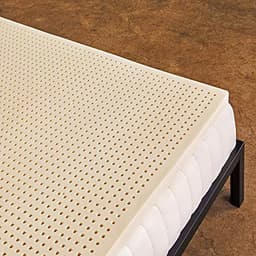
Sleep On Latex Pure Green Natural Latex Topper — Firm, 3"
Heavier bodies who need a topper that resists rather than collapses, and who want certified organic materials
Latex springs back rather than staying compressed, which is the property that resists compression set — and this is the only 3-inch slab we cover carrying GOLS certified organic latex and Fair For Life certification. The queen is a stated 49 pounds, genuinely a two-person job, and this size publishes no warranty or trial.
$329.00 · See it on AmazonFull reviewPrice as of October 21, 2026. #ad How we’re funded
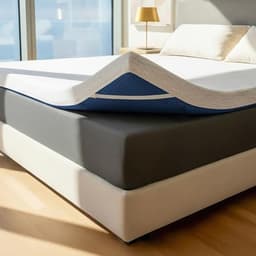
ViscoSoft 3" Select High Density Memory Foam Topper
Softening a too-firm bed for side sleepers with shoulder or hip pressure
The high-density default: enough density that it cushions a bony point instead of compressing flat under it, which is the same property that keeps it working in year three. CertiPUR-US named for the foam. It softens a bed rather than supporting one.
$179.95 · See it on AmazonFull reviewPrice as of October 21, 2026. #ad How we’re funded
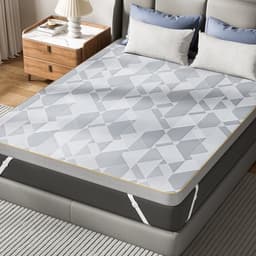
PERLECARE Firm Mattress Topper, 3"
Back and stomach sleepers whose mattress has softened under the hips
For a bed that has gone too soft: a thin memory-foam surface over a firm base, which is the right order for resisting sinkage, with both layers documented — CertiPUR-US for the foam and OEKO-TEX for the cover. Non-slip base and corner straps; no warranty published.
$129.99 · See it on AmazonSee the firm picksPrice as of October 21, 2026. #ad How we’re funded
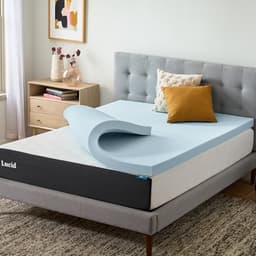
LUCID 3" Gel Memory Foam Topper
Trying a topper on a budget before committing to a pricier one
The cheap one, with its trade-off stated plainly: lower density than the ViscoSoft, so less durable and less supportive over time. It is the right buy for finding out whether a topper helps you at all, and the wrong buy if you want it to last.
$99.99 · See it on AmazonFull reviewPrice as of October 21, 2026. #ad How we’re funded
Four things that extend its life
Rotate it head to foot.Every few months, so the same two contact patches are not always the ones loaded. You cannot flip most toppers — dual-layer builds and latex slabs have a correct side up — but almost all of them can be turned end for end.
Never fold it for storage. Foam takes a set, and a crease becomes a permanent weak line. If a topper has to come off the bed, lay it flat or roll it loosely rather than folding it.
Keep sweat out of the foam.Neither memory foam nor latex can be machine washed, so anything that soaks in stays in. A cover or a protector is the only practical defense — do I need a mattress protector covers that decision, and non-toxic protectors the products.
Do not ask it to do a mattress’s job.A topper changes a surface. If what has failed is the support under your pelvis, the answer is the bed — mattress or topper works through which of the two your symptoms point at, and best mattress for back pain is the next step if it is the bed.
General guidance, not medical advice. Pillow & Post is written by an enthusiast, not a doctor or chiropractor. Back and joint pain can have serious causes — if yours is severe, persistent, or comes with numbness or weakness, see a qualified professional. A mattress is one piece of the picture, not a treatment.
Frequently asked questions
How long does a mattress topper last?
There is no authoritative interval and we are not going to invent one. What we can say is that none of the toppers we cover publishes a lifespan, most publish no warranty term at all, and the thing that ends a topper's life is compression set — permanent loss of thickness where your heaviest contact points press. Replace it when it fails the tests: the thickness under your hip no longer matches the edge, the symptoms it fixed have come back, or you can see a dip in it with the sheets off.
How do I know if my mattress topper is worn out?
Four tests. Strip the sheets and look for a visible hollow where you sleep. Press the middle of the topper and then an unused corner, and compare how far your hand goes and how fast it comes back. Measure the thickness at the corner and at your hip. And ask whether the problem it was bought to fix has returned. The last one is the most sensitive, because compression set is gradual and there is never a night when it obviously changes.
Does a mattress topper lose its firmness?
It loses thickness and resilience, which is experienced as losing firmness. Foam cells break down under repeated compression and stop returning to their original height, so the layer that used to spread your weight over a wide area stops doing it — most noticeably under the hip and shoulder, which are the two small patches taking most of your body weight when you lie on your side.
Does latex last longer than memory foam?
It is more resilient, which is the property that matters here: latex springs back rather than compressing and staying compressed. That is a structural argument rather than a tested claim — we have no durability data and will not pretend otherwise — and it comes with real costs: price, weight (the 3-inch queen Pure Green slab is a stated 49 pounds) and a firmer, springier feel than memory foam.
Will a topper last longer on a new mattress?
Yes, and this is the most common reason a topper dies early. A topper laid over a bed that has already developed a hollow is being flexed into that hollow every night, which concentrates compression exactly where the dip is. The topper then reproduces the dip, people conclude toppers do not work, and the actual fault is underneath. If you can see a trench in the mattress, fix that first.
Does a mattress topper warranty tell you how long it lasts?
No. A warranty is a contract about defects, not a prediction of lifespan, and under the Magnuson-Moss Warranty Act it has to disclose its terms and be designated full or limited — which usually means it covers manufacturing faults and specifically excludes normal softening. Most of the toppers we cover publish no warranty term at all, which we record as not published.
How can I make a mattress topper last longer?
Rotate it head to foot every few months so the same contact points are not always loaded. Do not fold or compress it for storage, because foam takes a set. Keep it in a cover or under a protector so sweat and skin oils are not soaking into the foam, which neither memory foam nor latex can be washed to remove. And do not put it on a failing mattress.
Is it cheaper to replace the topper or the mattress?
The topper, by a wide margin — which is exactly why it is worth checking which of the two is actually finished. If the mattress still supports you level and only the surface comfort has gone, a new topper is the right spend. If the bed has lost structural support, replacing the topper buys you a few months and then you buy it again.
Sources
- Cleveland Clinic — How To Choose a Mattress for Better Sleep (chiropractor Andrew Bang, DC; May 2023) — Recommends a medium-firm mattress and starting on the firmer side so a topper can adjust it; notes adjustable models give a lot of control to meet changing needs but tend to be pricey; suggests replacing a mattress around every 10 years and checking the return policy before buying (accessed September 18, 2026)
- Cleveland Clinic — Why Your Lower Back Pain Is Worse in the Morning — Names sleep position, hours of immobility, and an unsupportive mattress as the usual causes; advises a medium-firm (~6/10) mattress, replacement roughly every 6–8 years, and stretching before getting up (accessed August 12, 2026)
- FTC — Businessperson's Guide to Federal Warranty Law — Under the Magnuson-Moss Warranty Act a written warranty on a consumer product must disclose its terms and conditions in plain language and be designated 'full' or 'limited'; the FTC sets the standards a 'full' warranty must meet (accessed August 19, 2026)
- CertiPUR-US — Frequently Asked Questions — CertiPUR-US certifies the flexible polyurethane foam only, not the whole mattress, and does not address fiberglass fire barriers (accessed July 23, 2026)
- Control Union — Global Organic Latex Standard (GOLS) — Certifies organic latex products (≥95% certified organic latex by weight) and the finished product, with limits on harmful substances and emissions (accessed July 23, 2026)
Keep reading
Best mattress toppers for back pain
The replacement list — the whole field ranked on what each layer does to a bad back.
See the picksHow often to replace a mattress
The same question one layer down, where published guidance actually exists.
Read the guideMattress or topper?
If the topper is finished, whether to replace it or the bed under it.
Read the guideWarranties and sleep trials
Why a warranty term is not a lifespan, and what a limited one usually excludes.
Read the guide