Should You Sleep Without a Pillow?
Only if your body makes no gap to fill — which, for a side sleeper, it always does. Here is the test that settles it, the one clinical source that recommends trying no pillow, and why going without is almost never the cheapest fix.
How this is funded: we earn an Amazon commission if you buy through our links, at no extra cost to you. It never changes which product we recommend, and we’ll tell you plainly when to skip one. Full disclosure.
The short answer: for most people, no — and the reason has nothing to do with willpower, minimalism or posture. It is geometry. Your pillow is there to fill the gap your own body leaves between your head and the mattress, and the size of that gap is set by two things you cannot argue with: how you lie, and how far your shoulder sinks into the bed.
The rule we keep coming back to is from Cleveland Clinic’s pillow guidance, where chiropractor Andrew Bang, DC, puts it in one line: your pillow height should keep your neck parallel to the mattress, rather than bent up or down. Nothing in that rule says a pillow is compulsory. What it says is that the right answer is whatever leaves your neck level — which for some people really is nothing, and for others is three inches.
The one clinical recommendation to try it
This is worth putting up front, because it is usually missing from pages that answer this question. Cleveland Clinic’s stiff-neck self-care article — also Bang’s advice — includes this instruction under its mattress-and-pillow heading: try sleeping on a firm mattress without a pillow or with a special neck pillow.
So the idea is not fringe. But read the conditions, because they are doing a lot of work. It is offered to someone with a stiff neck they are trying to settle, it is one of several things to try alongside ice then heat, over-the-counter pain relief, gentle continued movement and slow range-of-motion stretches, and it specifies a firm mattress. It is an experiment with a setup, not a universal recommendation. The same article is clear about the deadline too: if self-care has not resolved the stiffness after two months, it is probably time to see a doctor.
Why the mattress is in that sentence
Because a soft bed and a firm bed give you completely different gaps on the same body. The published guidance states it directly: a firmer mattress needs a thicker pillow, because your shoulder sinks less into it; a memory foam topper or a pillow-top mattress needs a thinner pillow, because your shoulder sinks further.
Follow that logic to the end and something slightly counter-intuitive falls out. People often assume going pillowless suits a soft bed, because everything feels gentler. In fact the soft bed is the one that keeps movingunder you — your shoulder settles deeper over the first hours, which raises your torso relative to your head and tips your chin up. On a firm surface the gap is small and it stays the same all night, which is exactly the condition under which “no pillow” can be a stable answer rather than a drifting one. If your bed is on the soft end, our firmness guide covers where you actually sit on that scale.
Your position decides it, and the gaps are not close
Side sleepers: almost never
This is the clearest case on the page. Lie on your side and your shoulder becomes the widest part of you touching the mattress, propping your torso up by several inches while your head has nothing holding it at the same height. Take the pillow away and your head drops toward the bed, so your neck spends the night side-bent in one direction. Side sleepers need the mostloft of any position, not the least — it is the whole reason tall, firm pillows exist. Our pillows for neck pain roundup ranks the field on exactly that.
Back sleepers: a thin pillow, usually, rather than none
Lying on your back the gap is real but small — the hollow behind your neck where the cervical curve sits. With no pillow at all, your head rests flat on the mattress and that hollow is unsupported, and on a firm bed the chin can tip slightly back. With a thick pillow your chin is pushed down toward your chest. A thin pillow splits the difference, which is why the clinician-led guidance names a cervical contour pillow — using the lesselevated side under your head when you are on your back — as working best for most people. Going without is defensible on a firm bed and not the first thing we would try.
Stomach sleepers: yes, and that is the actual answer
Face-down, your head is already at mattress level and your neck is already turned. Add real loft and you crank it backward on top of the rotation. So for the head, no pillow or a very thin one is the right call, and this is where most of the genuine demand for this question comes from.
The honest complication is the position itself, not the pillow. Cleveland Clinic’s stomach-sleeping article states that it throws your alignment off by flattening and abnormally twisting your spine’s ideal curve, and that it extends your neck backward, compressing your spine; the Clinic’s neck-pain guidance warns separately against sleeping on your stomach with your head turned. If you want to move away from it, the Clinic’s own suggestion is mechanical rather than motivational: a few well-placed pillows as bumpers, to stop you rolling onto your front during the night, and it notes that this takes practice. And if you are staying put — most people do — a pillow under the hips reduces how far the lower back arches. Our stomach-sleeper picks are built around both of those.
The posture claim, and why it is not in this guide
A good share of the people searching this question are asking whether going pillowless will improve their posture, or undo a forward head position. We went looking for a clinical source that says it does and did not find one. The guidance we can cite frames pillow height as keeping your neck parallel to the mattress for the hours you are lying down — it does not extend that to what your spine does while you are standing up.
That is a negative result rather than a refutation, and we are reporting it as one. Eight hours in a neutral neck position is genuinely better than eight hours bent; it just does not follow that the way to get there is zero pillow rather than the right pillow. If posture is your reason, the lever with published clinical support behind it is movement and position, not pillow removal.
What to use instead of nothing
Here is the practical objection to literally sleeping on a bare mattress: you lose a washable surface, and you put the mattress cover against your ear and your face every night. A pillow thin enough to behave like almost nothing gives you the same geometry with a cover you can launder, which is why every pick below publishes its loft in inches instead of calling itself “low profile.”
And one of them is the reversible option. Take enough fill out of a shredded memory foam pillow and you have a near-flat pillow — with the fill in a bag if the experiment fails. That is the version of this test we would run first, because it is the only one you can undo.
What we would actually use instead
Three pillows that publish a loft figure low enough to be the honest alternative to none, and one you can empty out to find your own answer. Prices are live; we never print a number into the text.
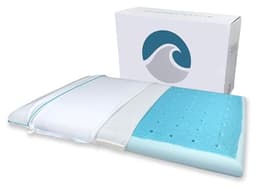
Bluewave Bedding Extra Slim Max Cool CarbonBlue Gel Memory Foam Pillow (1.75")
Dedicated stomach sleepers who find even low-profile pillows too tall
The thinnest pillow we cover at a published 1.75 inches, which is as close to no pillow as a product gets while still giving you a washable cover. The case for it over nothing is simple: a published number you can check against your own gap, rather than a mattress cover against your face.
Read the range review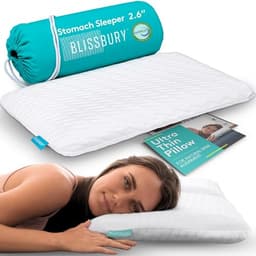
BLISSBURY Stomach Sleeper Pillow (2.6")
Combination sleepers who start on their stomach and roll onto their side
Built specifically for the position that generates most of this question, at a published 2.6 inches with CertiPUR-US foam named by the maker. If you are staying a stomach sleeper rather than training yourself out of it, this is the shape of pillow the position can tolerate.
See the roundup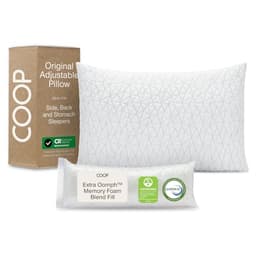
Coop Home Goods Original Adjustable Pillow
Anyone unsure of their loft, or who changes position through the night
The reversible experiment. Take the shredded fill out until the pillow is nearly flat, sleep on it for a week, and put the fill back if your neck disagrees — no other option here can be undone. It also carries CertiPUR-US for the foam and GREENGUARD Gold for emissions, which is the strongest certification pairing on any adjustable pillow we cover.
Full review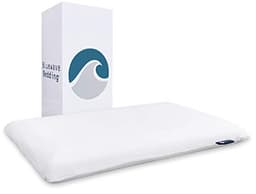
Bluewave Bedding Ultra Slim Gel Memory Foam Pillow (2.75")
Back and stomach sleepers whose neck hurts because their pillow is too tall
The step up at a published 2.75 inches, for the back sleeper who finds a true flat pillow leaves the chin tipping back on a firm bed. Still thin by any normal standard, and the one we would try before concluding that no pillow is the answer.
Full review
How to run the experiment properly
1. Measure the gap before you change anything. Lie down the way you actually fall asleep and get someone to look at your neck line from the front or behind. You are checking one thing: is your neck parallel to the mattress, or is it bent? Our too-high-or-too-low check is that test written out, and it costs nothing.
2. Note what your mattress is doing. Firm bed, bigger gap, thicker pillow. Soft or pillow-top bed, smaller gap, thinner pillow. If you added a topperrecently, that alone can have made your old pillow wrong — which is one of the quiet reasons people end up searching this question in the first place.
3. Give it a week.One night without a pillow feels odd whether it suits you or not. Change one variable at a time, and do not swap the pillow, the mattress and the position in the same week or you will not know which one did what. A genuinely new surface takes longer still — our adjustment-period guide covers that case.
4. Keep the other pillows. This is the mistake worth naming. Going without a head pillow does not mean sleeping flat on an empty bed: the clinician-led position guidance advises a small pillow under the knees for back sleepers, so the lower back does not over-arch, and a pillow between the legs for side sleepers, so the top leg does not drag the pelvis forward and twist the torso. Those are knee pillows and they are doing an entirely different job from the one under your head.
5. Stop if it hurts, and set a deadline.If you wake with a stiffer neck than you started with, the experiment has answered you — and the correction is a thinner pillow, not a longer run at no pillow. The same Cleveland Clinic article that suggests trying it also gives the limit: two months of self-care without improvement means it is time to see a doctor. The Clinic separately names numbness or tingling in the arms, weakness or loss of coordination, pain after an accident, and pain with fever or unexplained weight loss as reasons to be seen promptly.
So: who should actually do this?
A stomach sleeper, on any bed. Someone with a stiff neck on a genuinely firm mattress who wants to try the self-care experiment the Clinic describes. And a back sleeper on a firm bed who has already found that every pillow they own pushes their chin down.
Everyone else is better served by getting the heightright than by getting rid of it — and side sleepers should not try this at all. If you want the broader version of this argument, including the shape and material the published guidance names, we went through all of it in what pillow do chiropractors recommend.
A closing note on what this page is not. We own none of the pillows above and have slept on none of them; every loft figure is read from a product listing on a dated visit, and every clinical statement is quoted from the sources below rather than recalled. This is general guidance, not medical advice, and no pillow — or absence of one — treats anything.
General guidance, not medical advice. Pillow & Post is written by an enthusiast, not a doctor or chiropractor. Back and joint pain can have serious causes — if yours is severe, persistent, or comes with numbness or weakness, see a qualified professional. A mattress is one piece of the picture, not a treatment.
Frequently asked questions
Should you sleep without a pillow?
For most people, no — but it depends entirely on your sleeping position and how soft your mattress is. The published rule from Cleveland Clinic's chiropractor-authored pillow guidance is that your pillow should keep your neck parallel to the mattress, neither bent up nor folded down. That makes the real question how big a gap your body leaves: a side sleeper's shoulder creates a gap of several inches, so going without a pillow drops the head and kinks the neck for hours; a stomach sleeper creates almost no gap, which is the one case where no pillow is genuinely reasonable. Back sleepers sit in between and are usually best served by a thin pillow rather than none.
Is sleeping without a pillow good for your neck?
There is one clinical recommendation to try it. Cleveland Clinic's stiff-neck remedies article, in which chiropractor Andrew Bang, DC, gives the advice, says under its mattress-and-pillow heading: try sleeping on a firm mattress without a pillow or with a special neck pillow. Note the conditions attached — a firm mattress, and a stiff neck you are trying to settle. It is offered as one self-care experiment among several (ice then heat, over-the-counter pain relief, gentle movement, stretches), not as a general rule for everyone, and the same article says that if self-care has not worked after two months it is probably time to see a doctor.
Should you sleep without a pillow if you sleep on your stomach?
This is the position where going without is most defensible, because lying face-down leaves almost no gap between your head and the mattress, so any real loft cranks the neck backward. The bigger problem is the position itself. Cleveland Clinic's article on stomach sleeping states that it throws your alignment off by flattening and abnormally twisting your spine's ideal curve, and that it extends your neck backward, compressing your spine; the Clinic's neck-pain guidance separately warns against sleeping on your stomach with your head turned. If you are going to stomach-sleep anyway, no pillow or a very thin one is the right call for your head — and a pillow under your hips helps the lower back.
Does sleeping without a pillow improve your posture?
We could not find a clinical source that says so, and we are not going to assert it. The published guidance we rely on frames pillow height as a question of keeping your neck parallel to the mattress for the hours you are lying down — not as a way to change your standing posture. Eight hours in a neutral position is better for your neck than eight hours bent, which is a real benefit, but whether that is achieved with no pillow or a two-inch one depends on your shoulder and your mattress rather than on going without.
Can sleeping without a pillow cause neck pain?
Yes, in the same way a pillow that is too thick can. Both leave the neck held out of line for hours; they just fail in opposite directions. For a side sleeper the failure is almost guaranteed — the shoulder props the torso up while the head drops toward the mattress, so the neck is side-bent all night. If you wake with a stiff neck after going pillowless, the answer is usually a thinner pillow rather than none at all.
What should I use instead of a pillow?
A pillow thin enough to behave like almost nothing, which gives you a washable surface and a fraction of an inch of support rather than a hard mattress against your ear. The pillows built for this publish their loft in inches, and the ones we cover sit between roughly 1.75 and 2.75 inches. The alternative is an adjustable pillow you empty out: take enough fill out of a shredded-foam pillow and you have a near-flat one that can be put back if the experiment fails, which makes it the most reversible way to test the idea.
Is it better to sleep without a pillow on a soft or firm mattress?
Firm, and that is the condition attached to the one clinical recommendation we found — the Cleveland Clinic article says to try a firm mattress without a pillow, not just no pillow. The reason is geometry: on a soft or pillow-top bed your shoulder sinks in, which raises your body relative to your head and effectively tips your chin up. The same guidance states that a softer surface calls for a thinner pillow, not a missing one. On a genuinely firm bed the gap is small and consistent, so going without is far more likely to leave your neck level.
Sources
- Cleveland Clinic — Stiff Neck? Remedies to Find Neck Pain Relief (chiropractor Andrew Bang, DC) — Self-care remedies for a stiff neck from chiropractor Andrew Bang, DC: ice for the first 48 to 72 hours then heat, over-the-counter pain relievers, gentle continued movement while avoiding jerky motions, gentle massage, a soft neck collar only if a provider suggests one and not for long periods, and slow range-of-motion stretches. Under the heading 'Make sure you have the proper mattress or pillow' it gives the one instruction we cite for the no-pillow question: 'Try sleeping on a firm mattress without a pillow or with a special neck pillow.' On timing it says that if self-care has not resolved the stiffness after two months it is probably time to see a doctor. It lists no red-flag symptoms (accessed October 31, 2026)
- Cleveland Clinic — Is Your Pillow Giving You a Stiff Neck While You Sleep? (chiropractor Andrew Bang, DC) — The pillow guidance in this article comes from chiropractor Andrew Bang, DC. Pillow height should keep the neck parallel to the mattress rather than bent up or down, and the right thickness depends on mattress firmness — a firmer bed needs a thicker pillow, and a memory foam topper or pillow-top mattress needs a thinner one because the shoulder sinks further. Names a cervical contour pillow as working best for most people, with the lower side of the contour under the head on your back and the higher side on your side; names natural latex as generally the best material and feather pillows as causing the most neck pain; calls stomach sleeping not ideal but says a body or side pillow can improve sleep posture. Gives no loft measurement and no replacement interval (accessed October 24, 2026)
- Cleveland Clinic — Sleeping on Your Stomach: Is It Bad for You? (chiropractor Andrew Bang, DC) — States that stomach sleeping throws alignment off by flattening and abnormally twisting the spine's ideal curve, and that it extends the neck backward, compressing the spine. For anyone trying to stop, it advises using a few well-placed pillows as bumpers to keep from turning onto the stomach during the night, and notes it takes practice. The article does not address head-pillow thickness, pillows under the hips, knee pillows, mattress firmness, or sleeping without a pillow (accessed October 31, 2026)
- Cleveland Clinic — Neck Pain: 6 Common Causes and Treatments — Advises that back and side sleepers use a pillow that keeps the head and neck aligned, and warns against sleeping on the stomach with the head turned. Names numbness or tingling in the arms, weakness or loss of coordination, pain after an accident, and pain with fever or unexplained weight loss as reasons to seek care promptly (accessed September 18, 2026)
- Cleveland Clinic — Best Sleeping Positions for Pain — Back sleeping puts least pressure on the spine, with a small pillow UNDER the knees so the lower back does not over-arch; side sleepers put a pillow BETWEEN the legs to stop the top leg pulling forward and twisting the torso (accessed August 12, 2026)
- CertiPUR-US — Frequently Asked Questions — CertiPUR-US certifies the flexible polyurethane foam only, not the whole mattress, and does not address fiberglass fire barriers (accessed July 23, 2026)
Keep reading
Best pillows for stomach sleepers
The thin-pillow field, with the published loft in inches on each one — what to buy instead of nothing.
See the picksIs my pillow too high or too low?
The free mirror test that measures the gap your body actually makes, before you change anything.
Run the testWhat pillow do chiropractors recommend?
The full published guidance: a height rule, a shape, a preferred material, and the mattress clause that changes your answer.
Read the guidePillow loft for neck pain, by position
How much height each sleeping position needs, and how shoulder width changes the number.
Work it outBest adjustable pillows
The reversible way to test a near-flat pillow: take the fill out, and put it back if you were wrong.
See the picksHow often should you replace a pillow?
A pillow that has flattened is not the same thing as choosing to sleep without one. The tests that tell them apart.
Read the guide