What Pillow Do Chiropractors Recommend?
Not a brand — a rule, and it is one most pillow pages skip: the right height depends on how firm your mattress is. Here is the guidance in full, what it names, and what it refuses to name.
How this is funded: we earn an Amazon commission if you buy through our links, at no extra cost to you. It never changes which product we recommend, and we’ll tell you plainly when to skip one. Full disclosure.
The short answer is that chiropractors do not recommend a pillow. They recommend a rule, and the rule is more useful than any brand would be: your pillow should keep your neck parallel to the mattress, rather than bent up or down.
That line comes from the one piece of publicly available chiropractor-authored pillow guidance we could find — the Cleveland Clinic’s pillow article, in which chiropractor Andrew Bang, DC, gives the advice. We went looking for more and did not find it: no national chiropractic association publishes a standalone pillow guideline we could read, and the chiropractic-endorsement badges that appear on pillow listings are claims we cannot verify. So rather than pad this page with “chiropractors say” sentences nobody said, we are going to take the guidance that does exist and read it closely, because it contains four specific things and one condition that most pillow pages leave out entirely.
The guidance, in full
Four statements and a condition. Here is all of it, and then what each one means when you are standing in front of a shelf.
1. The height test.Your neck should stay parallel to the mattress — not bent up toward the ceiling, not folded down toward your chest. No inch figure is given, and that is the right call: the correct number is personal, because it depends on how wide your shoulders are and how far they sink. The test is positional, not numerical, which means you can run it tonight on the pillow you already own. Our too-high-or-too-low check is that test written out.
2. The shape. A cervical contour pillow is named as working best for most people, with a specific instruction on how to use one: the less elevated side of the contour goes under your head when you lie on your back, and the more elevated side when you lie on your side. That is a genuinely useful detail, because plenty of people buy a two-height contour pillow and never work out that the two heights are for two positions.
3. The material it prefers. Natural latex is named as generally the best pillow material.
4. The material it blames.Feather pillows are named as causing the most neck pain. Buckwheat gets a mention as supporting side sleepers, and stomach sleeping is called not ideal — though a body or side pillow is said to improve sleep posture for people who do it anyway.
And the condition that changes all of it. The right pillow thickness depends on how firm your mattress is. A firmer mattress needs a thicker pillow, because your shoulder sinks less into it. A memory foam topper or a pillow-top mattress needs a thinner pillow, because your shoulder sinks further. This is the sentence worth taking away from the whole page: your pillow is not a standalone purchase, it is the second half of a two-part system, and the first half is whatever you are lying on.
What that condition means in practice
It means four ordinary events silently make your pillow wrong, and none of them involves the pillow.
You bought a new mattress.Different surface, different shoulder depth, different correct loft. This is the most common version of “I bought a good bed and my neck got worse”, and it is why we weight sleep-trial length so heavily on our mattresses for neck painpage — you need weeks, not nights, to re-tune the pillow afterward.
You added a topper. A topper is a deliberate change to how far your shoulder sinks, so it is also a deliberate change to the pillow height you need. If you are planning both, plan them in that order and re-check the pillow after. Our topper picks and mattress-or-topper guide cover that decision.
Your mattress sagged.A bed that has developed a dip lets you sink further than it used to, which means the pillow that was right three years ago is now too thick. The pain shows up in your neck and the fault is in the mattress — how to fix a sagging mattress is the page for that.
You changed position. Side sleeping needs the most loft of any position, because the pillow has to fill the gap your shoulder makes; back sleeping needs less; stomach sleeping needs the least. If you move between positions through the night, a pillow with one fixed height cannot be right for all of them, which is the argument for adjustable fill or a two-height contour. Our loft guide by position works through the numbers.
Where the guidance stops, and we will not fill the gap
Three things the published advice does not say, which we are flagging because other pages will happily say them for it.
It does not name a brand, a model, or a price. It does not give a loft measurement in inches. And it does not give a replacement interval for a pillow — so when you read “chiropractors say replace your pillow every 18 months”, that number is not coming from the guidance we are citing. What it implies instead is a trigger: replace the pillow when it stops keeping your neck parallel, which includes the day your bed changes underneath it. The practical signs are in our how often to replace a pillow guide.
A note on endorsement claims, since they are the reason a lot of people search this question in the first place. Some pillow listings carry a chiropractic endorsement or a “chiropractor recommended” badge — one of the knee pillows in our registry does, and we record the claim on its page and deliberately do not repeat it as evidence, because we have not seen what was assessed or on what terms. We would treat any such badge the same way: as marketing until the underlying document is readable. That is the same standard we apply to certification logos without certificate numbers in our certification decoder.
What a chiropractor-informed shortlist actually looks like
Read the four statements together and they do not point at a product — they point at a decision tree. Do you know your loft? If yes, buy the shape that is built for your position. If no, buy the pillow whose height you can change, because every fixed-loft pillow is a bet and the guidance gives you no number to bet on. Then, within either answer, prefer the material that holds the height you set.
The picks below are the registry products that fit that tree, in the order we would work through it. Each links to the page where we argue it in full.
The pillows that fit the published rule
One per branch of the decision: the two-height contour the guidance describes, the adjustable pillow for anyone who does not yet know their loft, the natural-latex option it names as generally best, and the side-sleeper contour. Prices are live; we never print a number into the text.
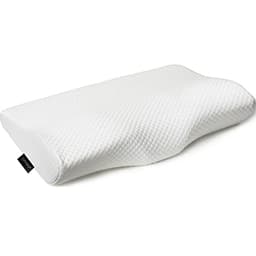
EPABO Contour Memory Foam Pillow
Back and side sleepers who want an inexpensive orthopedic contour pillow
The cheapest pillow we cover that is literally the object the guidance describes: a cervical contour with two different loft sides, so the lower side can go under your head on your back and the higher side on your side. CertiPUR-US foam is named by the maker. It is a fixed contour, so buy it when your loft need is settled rather than while you are still finding it.
$36.99 · See it on AmazonFull reviewPrice as of October 24, 2026. #ad How we’re funded
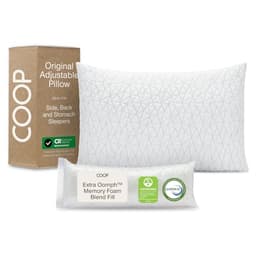
Coop Home Goods Original Adjustable Pillow
Anyone unsure of their loft, or who changes position through the night
The answer to the condition rather than the rule. Because the correct thickness depends on your mattress, a pillow whose fill you add and remove is the only one that can still be right after you change your bed or add a topper. It also carries both CertiPUR-US for the foam and GREENGUARD Gold for emissions, which is the strongest certification pairing on any adjustable pillow we cover.
$89.00 · See it on AmazonFull reviewPrice as of October 24, 2026. #ad How we’re funded

Turmerry Green Natural Latex Pillow (Standard, High Loft)
Back and side sleepers who want the fill itself certified, not just the cover
Natural latex is the material the guidance names as generally best, and this is the one solid-latex pillow we cover — GOLS-certified fill in a GOTS cotton case, zoned softer through the center and firmer at the edges. Resilient rather than viscoelastic, so the height you set at bedtime is the height you still have at 3am. Fixed loft in two published heights, and no warranty or trial is stated.
$89.00 · See it on AmazonFull reviewPrice as of October 24, 2026. #ad How we’re funded
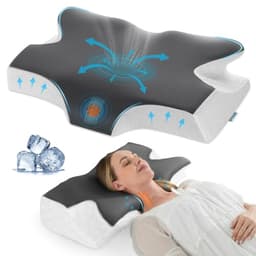
Elviros Cervical Memory Foam Pillow (Cooling)
Side sleepers whose neck kinks on a flat pillow
The contour built specifically around a side sleeper's shoulder, with cutouts that give the arm somewhere to go and a dual height that fills the gap between neck and mattress. Side sleeping needs the most loft of any position, which is exactly where a flat pillow fails. CertiPUR-US foam named by the maker; the prescriptive shape takes some getting used to.
Full review
The order we would do this in
1. Test before you buy. Lie down the way you actually sleep and get someone to look at your neck line. The rule costs nothing to apply, and the most common outcome is that the pillow you own is wrong by an inch in a direction you can correct for free by removing fill or folding a towel under the case to test the other direction.
2. Fix the bed question before the pillow question, if the bed is the problem.If your mattress has a visible dip, no pillow height will hold because the depth your shoulder reaches keeps changing. If your bed is sound but too hard or too soft for you, the Cleveland Clinic’s own mattress advice from the same chiropractor is medium-firm, and to start on the firmer side so a topper can soften it afterward — we went through that in what mattress do chiropractors recommend.
3. Buy adjustable if you are guessing, fixed if you are not. This is the one place the guidance leaves a real gap, since it names a shape but no height. An adjustable pillow converts a guess into an adjustment, which is why it is the lower-risk first purchase for most people — see our adjustable picks. If you already know your loft and your position, the contour is the more supportive object. There is one pillow we cover that is adjustable andmade of the material the guidance prefers, and it is the most expensive thing in the category — our Avocado Organic Cotton Pillow review works through whether that premium is worth paying.
4. Deal with the rest of your body, not just your head. A head pillow is one of several pillows in a sleep system. The clinician-led position guidance advises a small pillow under the knees for back sleepers so the lower back does not over-arch, and a pillow between the legs for side sleepers so the top leg does not pull the pelvis forward and twist the torso. Those are knee pillows, and on a lower-back or hip complaint they do more than anything under your head will.
5. Re-check after any change.New bed, new topper, new position, or a bed that has aged — each one moves the target. The pillow is the cheap half of the system and the half you are allowed to get wrong a couple of times.
What we are not telling you
That a pillow treats a neck problem, or that we have tested one. We own no units and have slept on none of the pillows above; every spec we publish is read from a product listing on a dated visit, and the clinical statements on this page are quoted from the sources below rather than summarized from memory. This is general guidance, not medical advice, and it is not a substitute for seeing a clinician — the Cleveland Clinic names numbness or tingling in the arms, weakness or loss of coordination, pain that follows an accident, and pain with fever or unexplained weight loss as reasons to be seen promptly. No pillow is the answer to any of those.
General guidance, not medical advice. Pillow & Post is written by an enthusiast, not a doctor or chiropractor. Back and joint pain can have serious causes — if yours is severe, persistent, or comes with numbness or weakness, see a qualified professional. A mattress is one piece of the picture, not a treatment.
Frequently asked questions
What pillow do chiropractors recommend?
There is no single brand. The one piece of publicly available chiropractor-led pillow guidance we could find — Cleveland Clinic's pillow article, in which chiropractor Andrew Bang, DC, gives the advice — names a rule rather than a product: pillow height should keep your neck parallel to the mattress rather than bent up or down. On top of that it names a shape (a cervical contour pillow works best for most people), a material it prefers (natural latex, described as generally the best), a material it blames (feather pillows cause the most neck pain), and one condition that changes everything: the right thickness depends on how firm your mattress is.
Do chiropractors recommend a thick or thin pillow?
Neither in the abstract — it depends on your bed and your position. The published rule is that a firmer mattress needs a thicker pillow because your shoulder sinks less into it, and a memory foam topper or pillow-top mattress needs a thinner one because your shoulder sinks further. Position stacks on top of that: a side sleeper needs the most height because the pillow has to fill the gap the shoulder makes, a back sleeper needs less, and a stomach sleeper needs the least of all.
Do chiropractors recommend memory foam or latex pillows?
The guidance names natural latex as generally the best pillow material. It does not condemn memory foam, and we would not either — but the stated preference lines up with a mechanical difference worth knowing: latex is resilient and springs back, so the height you set holds through the night, while memory foam softens where your body warms it, so a contour can read lower at 3am than it did at bedtime. The same article names feather pillows as causing the most neck pain.
Do chiropractors recommend cervical contour pillows?
The guidance says a cervical contour pillow works best for most people, and explains how to use one: the less elevated side of the contour goes under your head when you are on your back, and the more elevated side when you are on your side. It is a prescriptive shape, so it suits someone whose loft need is settled better than someone still working it out — a fixed contour at the wrong height is worse than an adjustable pillow at the right one.
Is there an official chiropractic pillow recommendation or endorsement?
Not one we can verify. We found no standalone pillow guideline published by a national chiropractic association, and some pillow listings carry chiropractic-endorsement claims — one of the knee pillows we cover does — which we record as the maker's claim and deliberately do not repeat as evidence, because we have not seen the underlying document. Treat an endorsement badge as marketing until you can read what was actually assessed. The clinician-authored guidance in the sources below is the strongest thing we could find, and it names a rule rather than a brand.
How often do chiropractors say to replace a pillow?
The article we rely on does not give a replacement interval, so we are not going to invent one. What it does imply is a trigger rather than a timetable: replace the pillow when it no longer keeps your neck parallel to the mattress — which includes the day your mattress or topper changes, because that changes how far your shoulder sinks. We cover the practical signs separately in our how-often-to-replace-a-pillow guide.
What sleeping position do chiropractors recommend?
Cleveland Clinic's clinician-led position guidance puts back sleeping first, because it puts the least pressure on the spine, with a small pillow under the knees so the lower back does not over-arch; for side sleeping it advises a pillow between the legs so the top leg does not pull the pelvis forward and twist the torso. On the neck specifically, the Clinic advises that back and side sleepers use a pillow that keeps the head and neck aligned, and warns against sleeping on your stomach with your head turned.
Sources
- Cleveland Clinic — Is Your Pillow Giving You a Stiff Neck While You Sleep? (chiropractor Andrew Bang, DC) — The pillow guidance in this article comes from chiropractor Andrew Bang, DC. Pillow height should keep the neck parallel to the mattress rather than bent up or down, and the right thickness depends on mattress firmness — a firmer bed needs a thicker pillow, and a memory foam topper or pillow-top mattress needs a thinner one because the shoulder sinks further. Names a cervical contour pillow as working best for most people, with the lower side of the contour under the head on your back and the higher side on your side; names natural latex as generally the best material and feather pillows as causing the most neck pain; calls stomach sleeping not ideal but says a body or side pillow can improve sleep posture. Gives no loft measurement and no replacement interval (accessed October 24, 2026)
- Cleveland Clinic — Neck Pain: 6 Common Causes and Treatments — Advises that back and side sleepers use a pillow that keeps the head and neck aligned, and warns against sleeping on the stomach with the head turned. Names numbness or tingling in the arms, weakness or loss of coordination, pain after an accident, and pain with fever or unexplained weight loss as reasons to seek care promptly (accessed September 18, 2026)
- Cleveland Clinic — How To Choose a Mattress for Better Sleep (chiropractor Andrew Bang, DC; May 2023) — Recommends a medium-firm mattress and starting on the firmer side so a topper can adjust it; notes adjustable models give a lot of control to meet changing needs but tend to be pricey; suggests replacing a mattress around every 10 years and checking the return policy before buying (accessed September 18, 2026)
- Cleveland Clinic — Best Sleeping Positions for Pain — Back sleeping puts least pressure on the spine, with a small pillow UNDER the knees so the lower back does not over-arch; side sleepers put a pillow BETWEEN the legs to stop the top leg pulling forward and twisting the torso (accessed August 12, 2026)
- Control Union — Global Organic Latex Standard (GOLS) — Certifies organic latex products (≥95% certified organic latex by weight) and the finished product, with limits on harmful substances and emissions (accessed July 23, 2026)
- CertiPUR-US — Frequently Asked Questions — CertiPUR-US certifies the flexible polyurethane foam only, not the whole mattress, and does not address fiberglass fire barriers (accessed July 23, 2026)
- UL Solutions — UL GREENGUARD Certification — GREENGUARD Gold limits emissions of 360+ VOCs to the stricter thresholds set for schools and healthcare — an emissions standard, not a materials ban (accessed July 23, 2026)
Keep reading
Is my pillow too high or too low?
The free test that applies the parallel-neck rule to the pillow you already own, before you spend anything.
Run the testBest pillows for neck pain
The full field, ranked on loft and fit — the two things the published guidance actually turns on.
See the picksWhat mattress do chiropractors recommend?
The same question one layer down, from the same chiropractor: medium-firm, and start on the firmer side.
Read the guideBest adjustable pillows
The lower-risk buy when you do not yet know your loft — a pillow you are allowed to be wrong with.
See the picksPillow loft for neck pain, by position
How much height each sleeping position actually needs, and how body width changes the number.
Work it outBest mattresses for upper back pain
Why a pillow two inches too high rounds your thoracic spine all night — and what the bed underneath has to do with it.
See the picks