Why Does Arthritis Hurt More at Night?
Because motion is what keeps a joint's fluid moving, and sleep is the longest stretch of stillness you get. What follows from that — and what in a bedroom is actually worth changing.
How this is funded: we earn an Amazon commission if you buy through our links, at no extra cost to you. It never changes which product we recommend, and we’ll tell you plainly when to skip one. Full disclosure.
There is a straightforward answer to this, and it is not “pain is worse when you have nothing to distract you”. A physiatrist writing for the Cleveland Clinic puts the mechanism plainly: joints swell at night because motion is what keeps their fluid moving, and in bed you stop moving. A joint that has been still for four hours is both swollen and under-lubricated, and it protests when you finally ask it to work.
That single fact explains the shape of the whole problem — the ache that builds in the small hours, the dreadful first ten minutes of the morning, and why position matters far more at night than during the day. It also tells you what bedding can and cannot do. Nothing in a bedroom slows cartilage loss. What a bed decides is which position a provoked joint is held in for a third of your life, and how much of your weight lands on it.
What arthritis is doing while you lie there
Osteoarthritis is the most common type: the cartilage capping a joint wears away over time until the bones underneath start to rub when the joint moves. The Cleveland Clinic lists its most common sites as hands and fingers, knees, hips, the neck and the lower back, and estimates that more than eight in ten adults over 55 have some of it. Its symptoms are joint pain — especially on movement — stiffness, swelling near a joint, and reduced range of motion.
Read that list next to the stillness mechanism and the night-time picture assembles itself. Swelling rises with immobility. Stiffness is worst after the longest still period. Pain is provoked by movement, so the first movement after six still hours is the worst one you will make all day. None of that is about your pain threshold at 3am.
The four bedroom variables, in order of leverage
1. Position (free)
The cheapest and biggest lever, and the Cleveland Clinic's guidance is specific by joint. For hip pain: start on your side with a pillow between the legs, and avoid lying flat on your back. For back sleeping generally: a small pillow under the knees so the lower back does not over-arch. For side sleeping: something between the legs so the top leg stops pulling forward and twisting the torso. Each of those is a way of stopping a joint from being held at the end of its range for hours.
2. Pressure distribution (cheap)
Here is the Clinic's actual bedding sentence for sore joints, and it is more specific than most pages admit: a firmmattress, with a foam pad added on top if needed, to distribute weight and keep the joints aligned. Two parts. The firm surface keeps you in line; the pad spreads the load so a tender joint is not carrying your weight on a patch the size of a hand. When a shoulder or hip is the problem, that second part is usually the fix, and it costs a fraction of a new bed — our arthritis topper picks are built around it.
3. The pillow, if the joint is in your neck (cheap)
The neck is on the Clinic's list of common osteoarthritis sites, and it is the joint with the least ability to reposition itself while you sleep. The target is a loft that keeps the neck parallel to the mattress rather than bent up or down — and the correct height depends partly on how firm your mattress is, since a softer bed lets your shoulder sink and closes the gap. Our loft diagnostic is the test, and the arthritis pillow picks are the shortlist.
4. The mattress (expensive, and last)
Worth changing when it is genuinely failing — a visible hollow where you sleep means the support core has gone and no amount of padding brings it back. The Clinic elsewhere names an unsupportive mattress among the usual causes of back pain that is worse in the morning, alongside sleep position and the hours of immobility themselves. But it is the slowest, costliest change, and the three levers above are the ones to exhaust first. If the bed is the fault, the arthritis mattress roundup ranks the field on spreading load rather than cushioning a single joint.
The three cheapest things that change a night
Picked against the Cleveland Clinic's own two-part advice — a supportive surface with a pad to distribute weight, and a pillow between the legs for the hip. Cheapest first; none of these treats arthritis.

ComfiLife Orthopedic Knee and Leg Pillow
Side sleepers who want the category standard at the lowest sensible price
The pillow between the legs, which is the Clinic's first suggestion for hip pain and its standard side-sleeping advice generally. A compact high-density foam contour that keeps the knees apart so the pelvis stops rotating. It is the least expensive item on this site and the one we would try tonight. Its listing names no foam certification, which we record as not published.
$24.95 · See it on AmazonSee the knee pillowsPrice as of October 21, 2026. #ad How we’re funded
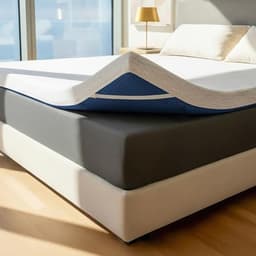
ViscoSoft 3" Select High Density Memory Foam Topper
Softening a too-firm bed for side sleepers with shoulder or hip pressure
The 'foam pad on top' half of the Clinic's advice: three inches of high-density memory foam, dense enough to spread load across a tender shoulder or hip instead of compressing flat under it. CertiPUR-US named for the foam. It softens a bed rather than supporting one, so it is the wrong buy if your mattress already sags.
$179.95 · See it on AmazonSee the arthritis toppersPrice as of October 21, 2026. #ad How we’re funded
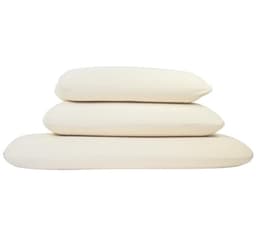
Turmerry Green Natural Latex Pillow (Standard, High Loft)
Back and side sleepers who want the fill itself certified, not just the cover
For an arthritic neck that cannot tolerate a loft that drifts: a one-piece zoned latex core that springs back rather than compressing to whatever the head weighs, so the angle at 3am is the angle at bedtime. It publishes its loft in inches — rare — and states GOLS organic latex with a GOTS cotton cover. Fixed loft, heavy, and not an option with a latex allergy.
$89.00 · See it on AmazonFull reviewPrice as of October 21, 2026. #ad How we’re funded
Two things that are free and get skipped
Change how you get out of bed.The worst movement of the day is the first one, and most people make it the hardest possible version — sitting straight up from flat. Rolling to your side and pushing up with an arm spreads that load. The Clinic's morning-pain guidance goes further and suggests stretching before you get up at all.
Stop changing two things at once. Arthritis pain fluctuates on its own, so a week in which you changed the pillow, the knee support and the room temperature teaches you nothing. Change one, give it a week, keep the rest constant. With a condition that varies by itself, this discipline is the difference between learning something and spending money.
What this page is not
It is not medical advice, and it is not a claim that bedding treats arthritis. We own none of the products we cover, run no clinic and have no data of our own; every mechanism above is cited to the authority that published it, and the bedding conclusions drawn from those mechanisms are ours and labelled as such. Heat, ice, medication and exercise all belong with the clinician who knows your diagnosis. What we can help with is the eight hours when you are not moving — which, on the Clinic's own account of why joints hurt at night, is the part of the day that does the damage. How we choose sets out the rest of the method.
General guidance, not medical advice. Pillow & Post is written by an enthusiast, not a doctor or chiropractor. Back and joint pain can have serious causes — if yours is severe, persistent, or comes with numbness or weakness, see a qualified professional. A mattress is one piece of the picture, not a treatment.
Frequently asked questions
Why does arthritis hurt more at night?
The mechanism a Cleveland Clinic physiatrist gives is stillness: joints swell at night because motion is what keeps their fluid moving, and in bed you stop moving. Add the fact that eight unbroken hours in one position is far more provocative than the same position for ten minutes while you are awake and shifting, and you have the ache that arrives in the small hours and peaks in the first few minutes of the morning.
Why is my arthritis worse in the morning?
It is the same mechanism read at its end point — a joint that has been still and swelling for hours is stiffest when you first ask it to move. The Cleveland Clinic names hours of immobility, sleep position and an unsupportive mattress among the usual causes of lower back pain that is worse in the morning, and advises stretching before getting up rather than levering yourself straight out of bed.
Does a mattress make a difference to arthritis pain?
It decides what position a joint is held in for a third of the day, which is a mechanical lever rather than a treatment. The Cleveland Clinic's advice for sore joints is specific: a firm mattress, with a foam pad added on top if needed, to distribute weight and keep the joints aligned. That is a two-part recommendation and the second part is the cheaper one.
What is the best sleeping position for arthritis?
It depends which joint. For hip pain the Clinic advises starting on your side with a pillow between the legs and avoiding lying flat on your back; for back sleeping generally, a small pillow under the knees so the lower back does not over-arch. For an arthritic neck the lever is the pillow's height — the neck should stay parallel to the mattress rather than bent up or down.
Should I use heat or ice on arthritis at night?
That is a question for the clinician who knows your diagnosis, and we are not going to answer it — it differs by type of arthritis and by joint. What this site can speak to is the mechanical half: position, support and pressure distribution, which are the things a mattress, a topper and a pillow actually change.
Does osteoarthritis affect the neck and back?
Yes. Osteoarthritis is the most common type of arthritis, happening as the cartilage capping a joint wears away until the bones underneath rub, and the Cleveland Clinic lists the neck and the lower back among its most common sites alongside hands, knees and hips. More than eight in ten adults over 55 have some of it.
Will a softer mattress help arthritis?
Not usually, and it is the intuitive mistake. A soft bed lets the heaviest parts of you sink, so the joints above and below take the strain of holding you in line — and a too-soft surface makes rolling over, which is how you relieve a still joint, into real work. The Clinic's own framing is a firm surface plus a pad to spread load, which is a different thing from a plush bed.
Why does it hurt more to move after lying still?
Because the fluid that lubricates a joint depends on movement to circulate, so a joint that has not moved for hours is both swollen and under-lubricated when you ask it to work. That is the Clinic's explanation for why sore joints ruin sleep, and it is why the first ten minutes of the morning are the worst ten minutes of the day.
Sources
- Cleveland Clinic — How To Keep Sore Joints From Ruining Your Sleep (physiatrist Geraldine Dapul, MD; January 2022) — Joints swell at night because motion is what keeps their fluid moving; for hip pain, start on your side with a pillow between the legs and avoid lying flat on your back; recommends a firm mattress with a foam pad added on top if needed to distribute weight and keep the joints aligned (accessed September 18, 2026)
- Cleveland Clinic — Osteoarthritis: Symptoms, Causes & Treatment — Osteoarthritis is the most common type of arthritis, sometimes called degenerative joint disease: the cartilage capping the bones in a joint wears away over time until the bones begin to rub against each other. It can develop in any joint but is most common in the hands and fingers, knees, hips, neck and lower back, and experts estimate more than 8 in 10 adults over 55 have it. Symptoms listed include joint pain especially on movement, stiffness, swelling near a joint and a decreased range of motion. Says nothing about bedding (accessed October 17, 2026)
- Cleveland Clinic — Best Sleeping Positions for Pain — Back sleeping puts least pressure on the spine, with a small pillow UNDER the knees so the lower back does not over-arch; side sleepers put a pillow BETWEEN the legs to stop the top leg pulling forward and twisting the torso (accessed August 12, 2026)
- Cleveland Clinic — Why Your Lower Back Pain Is Worse in the Morning — Names sleep position, hours of immobility, and an unsupportive mattress as the usual causes; advises a medium-firm (~6/10) mattress, replacement roughly every 6–8 years, and stretching before getting up (accessed August 12, 2026)
- CertiPUR-US — Frequently Asked Questions — CertiPUR-US certifies the flexible polyurethane foam only, not the whole mattress, and does not address fiberglass fire barriers (accessed July 23, 2026)
Keep reading
Best pillows for arthritis in the neck
The neck is one of the most common osteoarthritis sites, and a pillow is what holds it for eight hours.
See the picksBest mattress toppers for arthritis
The Cleveland Clinic's own second half: a foam pad over a firm bed to spread the load.
See the toppersBest mattresses for arthritis and joint pain
The bed itself, ranked on spreading weight across tender joints rather than cushioning one.
See the picksHow to sleep with arthritis pain
Position by position, including which joint changes the answer.
Read the guide