Is Memory Foam Toxic?
Three different worries get bundled into that one question, and each has a different answer. Here is what memory foam is, and exactly what each certification does and does not cover.
How this is funded: we earn an Amazon commission if you buy through our links, at no extra cost to you. It never changes which product we recommend, and we’ll tell you plainly when to skip one. Full disclosure.
Three questions wearing one costume
“Is memory foam toxic” is asked as one question and is really three, with three different answers and three different places to look them up. Separating them is most of the work.
The smell. A new foam bed or pillow releases volatile organic compounds, which is the chemical smell you notice on day one and have stopped noticing by week three. This is the question most people are actually asking, and we have a whole page on it: new mattress smell and off-gassing.
The additives, especially flame retardants. This is the worry with actual history behind it, and it is the one a certification can speak to directly.
Fiberglass. Which is not in the foam at all. It is a barrier wrapped around the foam, and the reason the question keeps getting attached to memory foam is that cheap all-foam beds are where glass-fiber barriers are most common. It is a separate object with a separate answer: how to tell if a mattress has fiberglass.
What memory foam is
Flexible polyurethane foam. It is made by reacting polyols with isocyanates, and the resulting foam is tuned with additives for density, for feel, and for marketing: gel infusions, charcoal, green tea, copper, graphite. Those names describe what has been added to a polyurethane foam, not a different material. A “gel memory foam” bed and a plain memory foam bed are the same chemistry with a different filler.
That matters for reading listings, because it means the material question is settled before you get to the brand: if it is memory foam of any description, it is polyurethane. The only genuinely different materials in this category are latex, which can be certified organic, and wool and cotton, which can be certified organic too. Everything else is a variation on the same foam.
What each certification actually covers
This is the part that decides whether a claim means anything, and the scopes do not overlap the way the badges imply.
CertiPUR-US is administered by the Alliance for Flexible Polyurethane Foam and tests foam for restricted content, low emissions and restricted flame retardants. Its own FAQ is explicit on two limits that matter: it certifies the foam, not the whole mattress, and it does not address fiberglass fire barriers. So it is a genuine claim about the largest component of the product and silent about the cover, the quilting, the dyes, the zip and the barrier.
GREENGUARD Gold is an emissions certification from UL Solutions. It limits emissions of more than 360 volatile organic compounds to the stricter thresholds set for schools and healthcare settings. If your worry is the air next to your face for eight hours, this is the mark aimed at it. It is not a materials ban: a polyurethane product can meet it and still be polyurethane.
OEKO-TEX STANDARD 100 is the textile-safety label. Every submitted component is tested against more than a thousand harmful substances, with stricter limits the closer the fabric sits to skin. On a foam product it covers the half CertiPUR-US does not: the cover.
GOTS and GOLSare the organic standards for textiles and for latex, and they are a different kind of claim altogether — they certify a material and its processing rather than testing a sample for substances. No memory foam can carry either, by definition.
MADE SAFEscreens finished products against a banned and restricted list of thousands of known harmful chemicals — the closest thing to a whole-product “nontoxic” certification in this space. We mention it because it is the standard people imagine CertiPUR-US to be, and nothing in our registry carries it.
The practical rule that falls out of this: a product naming a foam certification and a textile certification has covered both halves of itself; one naming either has covered half. The full scope table is in our certification decoder.
What we are not going to tell you
We are not going to tell you memory foam is safe, and we are not going to tell you it is dangerous. We have no laboratory, we test nothing, and the honest limit of a buying guide is reporting what each listing states and what each standard covers. Anyone who answers this question with confidence in either direction is either selling foam or selling the alternative.
What we can do is rank products by how much of themselves they document, which is what every roundup on this site does. On that measure the field separates clearly, and the separation is useful: a listing that names a certification for the foam, a certification for the fabric, and a fiberglass position has answered three questions. Most listings answer none.
Products whose listings answer the question
Three picks chosen for documentation rather than feel: a mattress that states a certification for the foam, a certification for the cover and a fiberglass-free build; the pillow with the emissions certification that matches a worry about air next to your face; and the topper class where the fiberglass question does not arise at all.
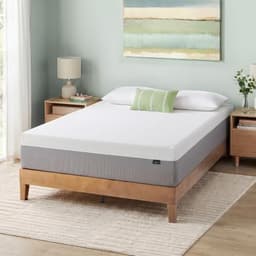
Zinus 12" Green Tea Essential Memory Foam
Back and combination sleepers who want certified, fiberglass-free foam on a budget
The all-foam bed that answers all three questions on one listing: CertiPUR-US for the foam, OEKO-TEX Standard 100 for the cover, and an explicit statement that there is no fiberglass anywhere in the construction, with a carbon-rayon flame barrier instead.
$219.99 · See it on AmazonFull reviewPrice as of October 20, 2026. #ad How we’re funded
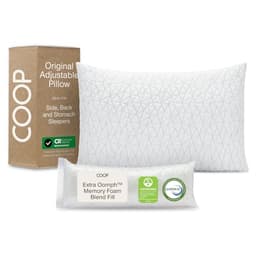
Coop Home Goods Original Adjustable Pillow
Anyone unsure of their loft, or who changes position through the night
The pillow that carries the emissions mark as well as the foam one — CertiPUR-US and GREENGUARD Gold, which limits more than 360 VOCs to school and healthcare thresholds. On the object closest to your airway, that is the certification that matches the worry.
Full review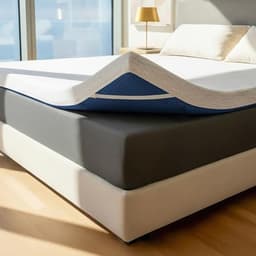
ViscoSoft 3" Select High Density Memory Foam Topper
Softening a too-firm bed for side sleepers with shoulder or hip pressure
A topper rather than a mattress, which removes the fiberglass question entirely: the federal open-flame rule applies to mattresses and mattress sets, so a topper has no fire barrier to build. CertiPUR-US named for the high-density foam.
$179.95 · See it on AmazonFull reviewPrice as of October 20, 2026. #ad How we’re funded
If you want to reduce exposure rather than argue about it
Four things that are within your control, in rough order of usefulness.
Air it before you sleep on it. Unwrap a foam product in a ventilated room and leave it. Several listings we cover ask for one to two days and one asks for 24 to 48 hours, which tells you the makers expect it. The off-gassing page covers what this does and does not achieve.
Buy the half you touch.A certified cover matters more than a certified core for the simple reason that you are against it. Where a listing only certifies the foam, a protector or a cotton cover is the cheap fix — see non-toxic mattress protectors.
Prefer listings that answer questions. Not because a stated claim is proof, but because a company that puts a sentence on a listing is accountable for it, and one that stays silent is not.
Consider latex if the material itself is the issue. It is the one route to a certified materialrather than a tested sample, and the one that passes flammability rules on wool rather than a barrier. It costs more, it is heavy, and it feels springy rather than slow — our latex vs memory foam guide weighs that honestly, and organic mattresses covers the beds.
Nothing on this page is medical or toxicological advice. If you have a diagnosed chemical sensitivity, the decision belongs with your clinician and not with a buying guide.
General guidance, not medical advice. Pillow & Post is written by an enthusiast, not a doctor or chiropractor. Back and joint pain can have serious causes — if yours is severe, persistent, or comes with numbness or weakness, see a qualified professional. A mattress is one piece of the picture, not a treatment.
Frequently asked questions
Is memory foam toxic?
The honest answer is that "toxic" bundles three different worries and each has a different answer. The smell from a new foam bed is volatile organic compounds leaving the foam, and it fades. Flame retardants are the chemical worry with history behind it, and CertiPUR-US restricts them. Fiberglass is not in the foam at all — it is a fire barrier wrapped around it, and no foam certification addresses it. We cannot tell you a product is safe; we can tell you which of the three each certification covers.
What is memory foam made of?
Flexible polyurethane foam — a petrochemical foam made by reacting polyols with isocyanates, with additives for density, feel, cooling gels and infusions. That is the same base material whether the listing calls it memory foam, gel foam, charcoal foam or green-tea foam; those names describe additives and marketing, not a different chemistry. Latex is the genuinely different material, and it is the one that can carry an organic certification.
What does CertiPUR-US actually certify?
The flexible polyurethane foam, and only that. The program is administered by the Alliance for Flexible Polyurethane Foam and tests foam for restricted content, low emissions and restricted flame retardants. Its own FAQ is clear that it certifies the foam rather than the whole mattress and does not address fiberglass fire barriers. So it is a real claim about the largest component and silent about the cover, the zip, the dyes and the barrier.
Does memory foam off-gas harmful chemicals?
New foam releases volatile organic compounds, which is what you smell, and the smell fades over days to weeks. Whether that matters to you is a judgment about exposure, and the certification built for exactly that question is GREENGUARD Gold: it limits emissions of more than 360 VOCs to the stricter thresholds set for schools and healthcare. It is an emissions standard, not a materials ban — a product can meet it and still be made of polyurethane.
Is memory foam safe for kids?
The same reasoning applies, with two practical differences: children spend more hours in bed and are closer to the surface. That makes emissions certification more relevant, not less, and makes the cover — which no foam certification covers — the component worth checking. All three children's twins we cover state CertiPUR-US foams and OEKO-TEX fabrics, which is both halves rather than one. Infant bedding is a separate subject with its own safe-sleep guidance.
Is memory foam the same as fiberglass?
No, and conflating them is the most common confusion in this category. Fiberglass, where it is present, is a woven glass-fiber sock around the foam core, used to pass the federal open-flame standard at 16 CFR Part 1633 — a performance rule that does not specify which barrier material a maker uses. It is not an ingredient of the foam, no foam certification covers it, and the only thing that speaks to it is an explicit fiberglass-free statement on the listing.
Which certification is the strongest for memory foam?
They answer different questions rather than ranking cleanly. CertiPUR-US covers the foam's content, emissions and flame retardants. GREENGUARD Gold is the stricter emissions standard and the one that matches a worry about air next to your face. OEKO-TEX Standard 100 tests textiles against a list of more than a thousand harmful substances, with tighter limits the closer the fabric sits to skin. A product naming a foam mark and a textile mark has covered both halves; one naming either has covered half.
Should I buy latex instead?
If what you want is a material that can be certified as a material rather than tested as a sample, yes — GOLS certifies organic latex and GOTS certifies organic cotton and wool, and beds built that way pass the flammability rule on wool rather than on a glass-fiber barrier. The costs are price, weight and feel: latex is springy rather than slow-sinking, so if you specifically like the memory-foam sensation you will not get it from latex.
Sources
- CertiPUR-US — Frequently Asked Questions — CertiPUR-US certifies the flexible polyurethane foam only, not the whole mattress, and does not address fiberglass fire barriers (accessed July 23, 2026)
- CertiPUR-US — About the certification — Program administered by the Alliance for Flexible Polyurethane Foam; tests foam for restricted content, low emissions and restricted flame retardants (accessed July 23, 2026)
- UL Solutions — UL GREENGUARD Certification — GREENGUARD Gold limits emissions of 360+ VOCs to the stricter thresholds set for schools and healthcare — an emissions standard, not a materials ban (accessed July 23, 2026)
- OEKO-TEX — STANDARD 100 — Textile-safety label: every submitted component tested against 1,000+ harmful substances, with stricter limits the closer the fabric is to skin (accessed July 23, 2026)
- MADE SAFE — Nontoxic Certified — Screens finished products against a banned/restricted list of thousands of known harmful chemicals (accessed July 23, 2026)
- CPSC — Mattresses, Mattress Pads & Mattress Sets (business guidance) — Mattresses sold in the US must meet the federal open-flame standard at 16 CFR Part 1633, which limits the size of the fire a mattress set produces in a 30-minute test — a performance requirement that does not specify which fire-barrier material a maker uses to meet it (accessed August 19, 2026)
Keep reading
Does memory foam sleep hot?
The other question people ask about the same chemistry, answered from published construction.
Read the guideThe certification decoder
Every mark we cover, what it certifies, what it does not, and how to verify one.
Read the decoderNew mattress smell and off-gassing
The smell question specifically — what it is, how long it lasts, and what airing does.
Read the guideBest non-toxic mattresses
The beds whose listings answer these questions, ranked on what each one documents.
See the picksHow to tell if a mattress has fiberglass
The worry that is not about the foam at all — and the one you can actually check.
Read the guide